Holy Connections
Today’s route is a conversation about how stone becomes a form of expressing inner anxiety: for oneself, for one’s place in the world, and for one’s people.
7 Points
3 h 13 min
17.5 km
Audio guide
The Romanian historian of religions, Mircea Eliade, in his book Symbolism, the Sacred, and Art, discusses how religious space is not simply embedded in the urban landscape: it either represents a hierophany—a manifestation of the sacred—or neighbours the "center of the world," that point where the world seems to hold itself on its own axis. We will not inscribe Belgrade into Eliade's scheme—the city is too stubbornly alive for a single dimension. But the train of thought itself is important: sacred architecture is never merely utilitarian.
Today's route is a conversation about how stone becomes a form of expression for inner anxiety: for oneself, for one's place in the world, for one's people. And also—about how Belgrade can absorb the pain of others, the pain of exile, and transform it into part of its own biography. Many points on our route are, in one way or another, connected to the Russian emigration: to people who arrived here by chance, but brought with them art, memory, and prayer.
The route is long—about 22 kilometers—so it's best to combine modes of transport: walk part of the way, use public transport or a taxi for another part, adjusting the pace to suit yourself.
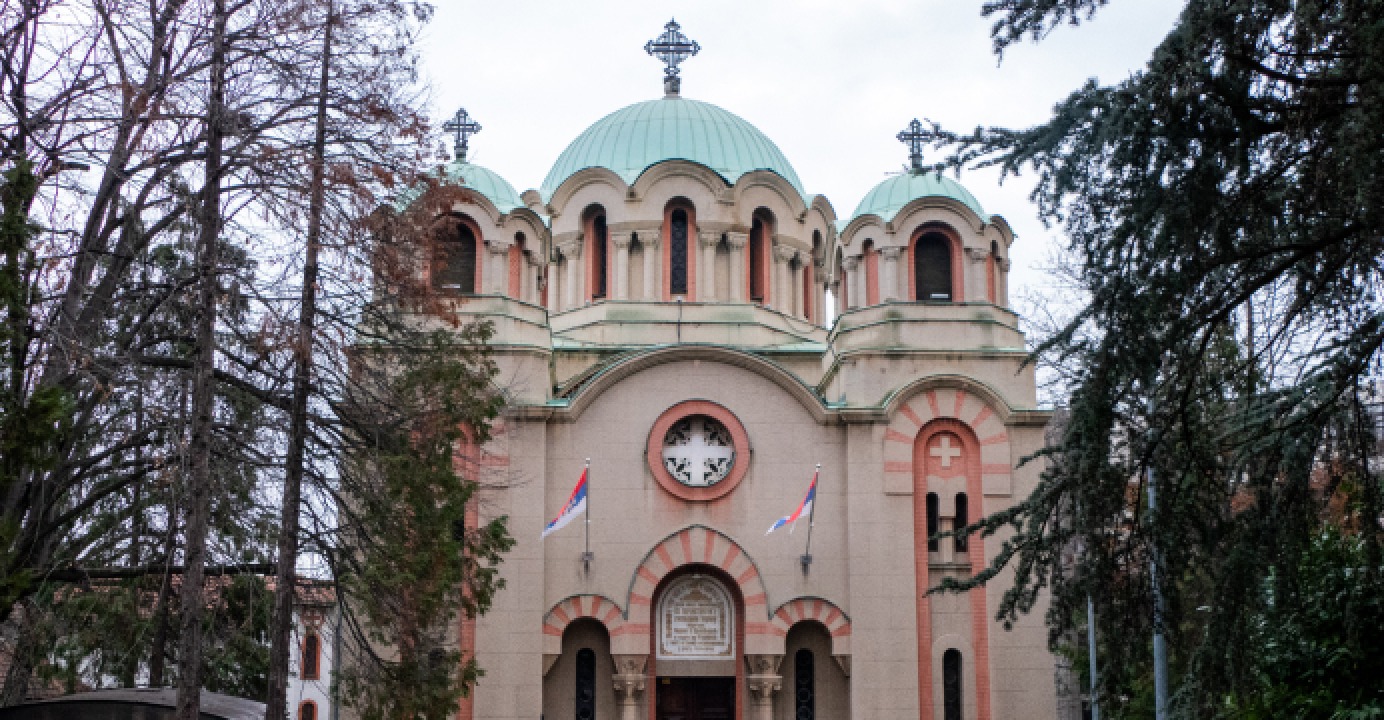
Stop 1. Church of the Archangel Gabriel (1939)
The first stop on our route does not overwhelm with scale — and that is precisely its importance. It represents a precise gesture of an era when interwar Yugoslavia was searching for a "national style" and, in sacred architecture, sought to speak the language of continuity: from the medieval Orthodox heritage to the modern state.
Before us is a church built in 1939 according to the design of architect Grigory Samoylov, a Russian émigré.
Architecturally, it is a triconch: a plan where the altar area and two lateral "shell"-conches form a three-lobed scheme. For Samoylov, the triconch is not merely a decorative element but the load-bearing logic of the space: the church is perceived as a compact, centric organism where everything strives towards the dome.
Look at the western facade: the entrance is flanked by two symmetrical bell towers. Here, Samoylov combines monumentality and "legibility": you do not get lost, you do not search for the center—it is indicated by the building's mass and understood on an intuitive level.
An important detail is the dominant dome drum. It does not dissolve but functions as an architectural accent, as the "voice" of the building.
At the same time, the church is not heavy: the drum is pierced by narrow window openings, and light gathers the space.
Another expressive detail: for Samoylov, "Byzantineness" does not turn into an act of restoring a museum heritage. It is emphasized, for example, by the massive semi-domes of the lateral conches and the characteristic arch above the portal—researchers note the horseshoe shape of this arch as an important feature of the image.
Before us is not a reconstruction of "how it was," but a modern interpretation, a careful rethinking of uniqueness, more of an attempt to pay tribute to tradition, not blind imitation.
And here is what is especially pleasing for the attentive listener: Samoylov designed the church as a complete entity, thinking not only about the walls but also about the inner "matter"—the iconostasis, the details, the decorative work. The interior features carved capitals with small bird figures, stained glass windows depicting animals, and a mosaic floor.
Now we move on—to a church where the Russian émigré line manifests itself differently.
Stop 2. Church of St. George on Banovo Brdo (1928–1932)
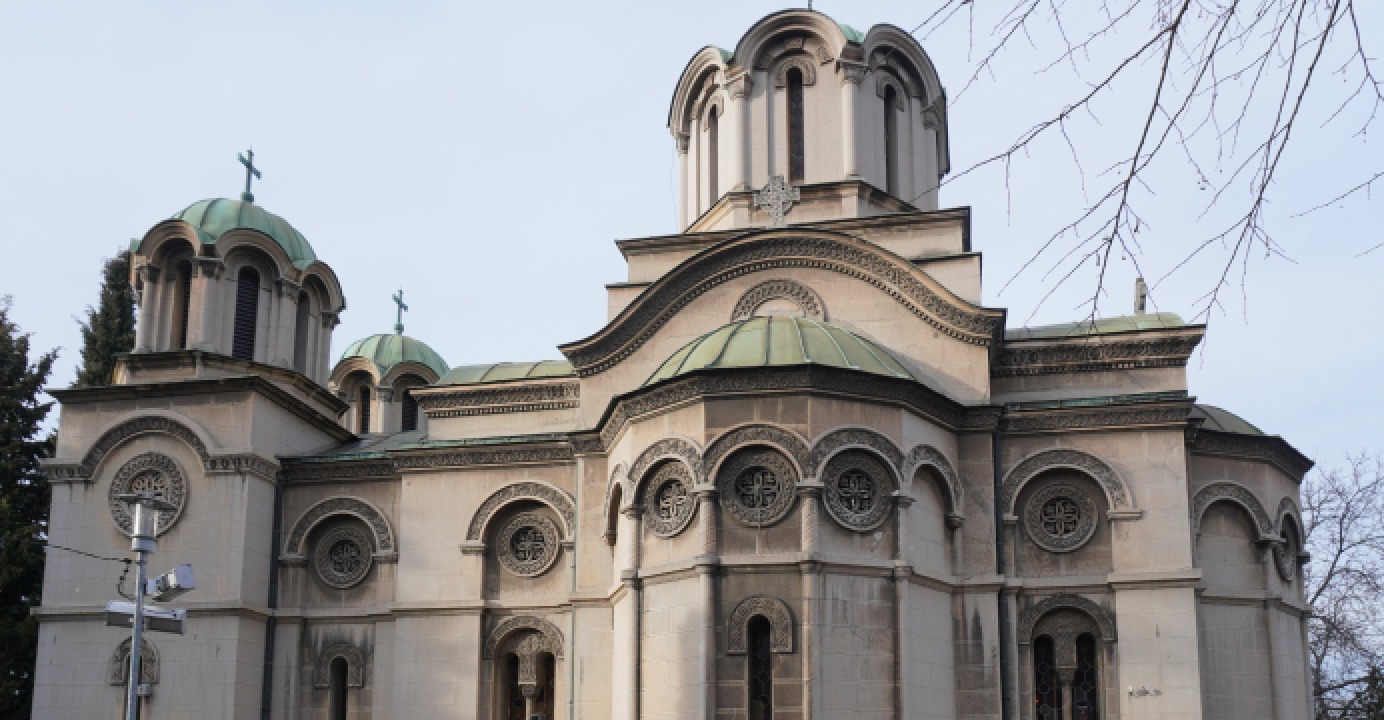
The Church of St. George on Banovo Brdo was built between 1928 and 1932 according to the design of Russian architect Vasily Androsov. A time when Belgrade was growing rapidly, acquiring its capital city status, and religious architecture became embedded in the urban fabric: the church needed to be a recognizable landmark, but in no way fall out of the "spirit of the times."
The idea for building the church is somewhat unusual for Belgrade of that era. It is a personal story, not a popular "state commission" of the period: in 1925, a Belgrade merchant, Mitar Jovanović, approached Patriarch Dimitrije with a request to build a church—in memory of his two children who had died young. He donated the land, asked for the church to be dedicated to St. George, the patron saint of his family, and for a family tomb to be built beneath it.
Architecturally, the church is designed as an inscribed cross, a trefoil, in Neo-Byzantine traditions characteristic of Belgrade's sacred buildings between the two world wars.
It is important to examine the apse: externally, it is pentagonal, internally, it is semicircular. The choir apses on the north and south sides open onto the nave, creating acoustic and spatial fullness.
Also, pay attention to the main entrance: it is accentuated by pillars. Even when the decoration is modest, the entrance must be marked: the church always builds a boundary between the secular and the sacred, between what is knowable by human experience and what lies far beyond it.
The wooden iconostasis is the work of Nestor Aleksievich. There are also large icons, among which the icon of St. Nicholas stands out—an original work by the Russian artist Kolesnikov. Here again, we see the characteristic mechanism of émigré presence: not "imitating a style," but weaving one's own skill into the local tradition.
Stop 3. Monastery of the Presentation of the Most Holy Mother of God (Vavedenje)
The Vavedenje Monastery is one of the important spiritual hubs connected to the Russian émigré milieu.
The complex includes the church and the monastic residential building, erected in 1937 as a gift from Belgrade benefactors Persida and Rista Milenković. The architectural history of the project is more complex than a single name: materials mention the authors of the church's design as Ivan A. Rik and Andrei V. Papkov.
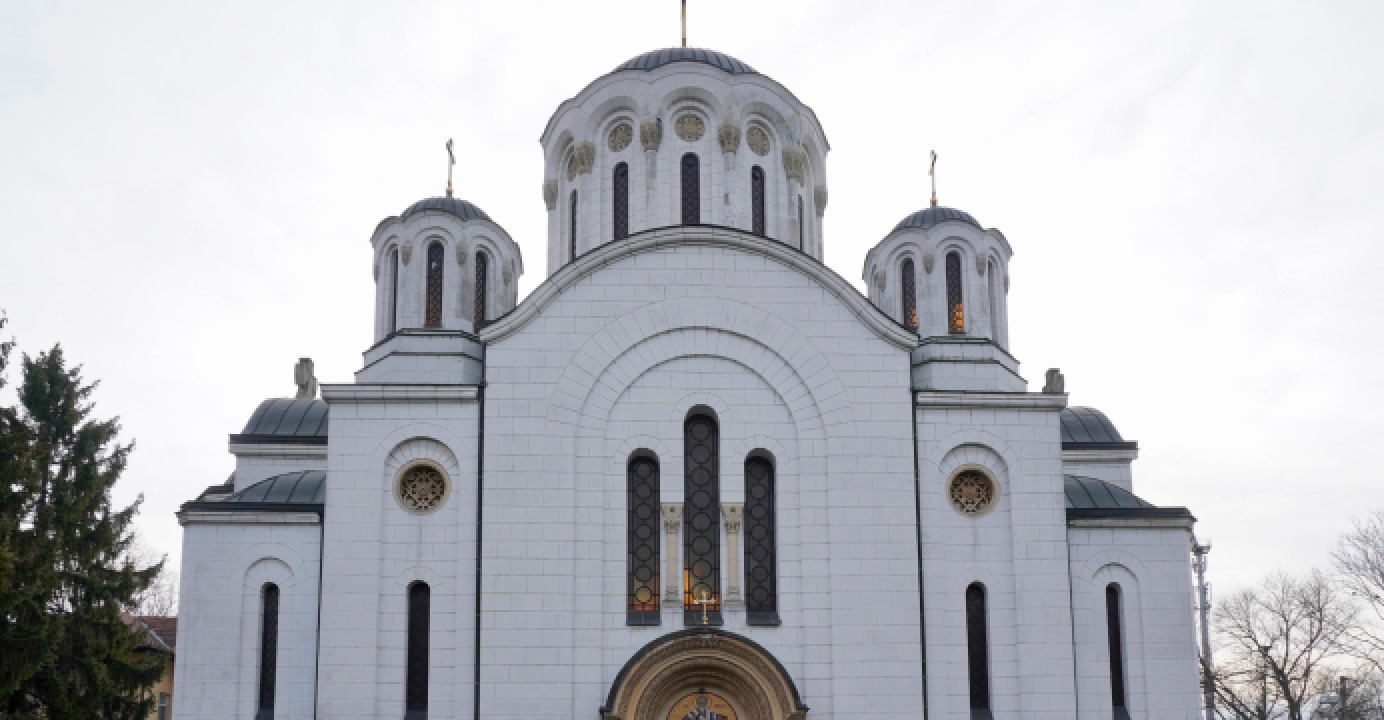
The architectural composition of the church is five-domed, based on a developed inscribed cross. The central dome is monumental, while four smaller ones are placed between the arms of the cross. In the very idea of the five domes, one hears a reference to Serbian medieval architecture of the 13th–14th centuries: this is not direct copying, but a tribute to the memory and respect for familiar motifs of the local culture.
In his essay on Marcel Proust's novel In Search of Lost Time, Merab Mamardashvili writes the following:
"Marcel dipped the 'madeleine' cookie into his cup of tea, and suddenly joy seized him again. But this time he understood its cause, was able to decipher it, to evoke from the taste of the cookie that delighted him, all the memories connected with his childhood and the places where he once was. He remembered the landscape, the river, the birds, the flowers—and all of this from a cup of tea, from a single sensation that coincided with a sensation he had experienced in the past."
In a sense, these reverences towards medieval architecture—gestures towards the Serbo-Byzantine style, subtly and masterfully embodied by Russian architects—became for the local inhabitants that very "madeleine cookie": they revived the memory of history and one's own roots, of that which many had encroached upon, but which no one had managed to destroy—nor, perhaps even more importantly, consign to oblivion.
Returning from literary references to architecture: what is important here is the tiered quality—the concentration of volumes towards the center. This is a technique that makes the church "ascending": you feel not only the vertical of the dome but also how the entire structure seems to gather at the highest point.
The decoration is restrained. Elongated window axes, rosettes as rare but precise accents, and an expressive triphora on the western facade are noted. The western portal is designed with particular solemnity, with a wide staircase.
Inside, the liturgical logic is clear: in the east, a spacious apse (semicircular inside, pentagonal outside), with access to the side chambers. The frescoes were executed later, in the 1970s–80s, but importantly, the architecture was originally designed to accommodate painting, furniture, and the church's acoustics.
Our next stop is the Small Church of St. Sava in Vračar.
Stop 4. Small Church of St. Sava in Vračar
The Small Church of St. Sava stands next to the majestic Church of St. Sava—and, in fact, for a long time served as a "temporary" church until the completion of the larger project.
The church was designed by Russian architect Viktor Lukomsky as a triconch. In its appearance, one can read the author's interpretation of Serbo-Byzantine motifs: once again, a careful and reverent act of reinterpreting classics in a new perspective.
Pay attention to the characteristic shape: a cubic structure with a polygonal dome. There are few openings, which creates a feeling of compactness, even asceticism. The whiteness of the facade organizes the space, while contrasting blind niches add rhythm: the church seems to "breathe" not through windows, but through the plasticity of the wall.
The interior decoration is also linked to the Russian artistic scene: the icons on the iconostasis are the work of Vladimir Predievich, while the wall frescoes are by artists N. Mayendorf, B. Obraskov, and A. Dikiy.
In the southern choir space lie the remains of Patriarch Varnava—chairman of the Committee for the Erection of the Memorial Church of St. Sava.
Now we move to a space where the symbol literally becomes the restoration of what was lost—to the chapel built as a response to the destruction of a shrine in Moscow.
Stop 5. Iveron Chapel at the New Cemetery (1930–1931)
The Iveron Chapel at the New Cemetery is a transferred shrine, a gesture of memory that is almost physically palpable: as if people said to themselves—since they destroyed it there, we will restore it here.
The chapel was built in 1930–1931 in the Russian section of the New Cemetery after the Soviet authorities destroyed the Iveron Chapel at the Resurrection Gate in Moscow in 1929. The project was designed by military engineer Valery Vladimirovich Stashevsky.
The fundraising is a story in itself. Donations came from the Yugoslav King Alexander I, Prince Paul, Princess Olga, from members of the Russian Imperial House in exile, from Russian and Serbian church communities, and from numerous émigrés around the world. This is important: the chapel was a common cause, assembled "thread by thread"—and therefore became a very enduring symbol.
The cornerstone was laid on April 22, 1930: Metropolitan Anthony (Khrapovitsky) of the Russian Orthodox Church Outside of Russia laid the foundation, and a handful of Russian soil was placed in it. On July 5, 1931, the chapel was consecrated by Serbian Patriarch Varnava and Metropolitan Anthony.
Now—about the architectural nuances. The chapel reproduced the demolished Moscow one but was taller and wider. Its appearance was carefully conceived in terms of colour: the facades were white, the fluted pilasters were green, the capitals and bases were yellow; the chapel was crowned by a blue semi-dome adorned with gold stars.
On the exterior walls, in niches, two large icons were placed: St. Nicholas—in memory of Emperor Nicholas II, and St. Alexis—in memory of Tsarevich Alexei; these icons were brought from Mount Athos. Inside, shrines from the "main cities of Russia" were gathered: in memory of Moscow—the Iveron Icon of the Mother of God (an Athonite copy); in memory of Kyiv—the Icon of the Dormition; in memory of Petrograd—a copy of the Icon of the Saviour Not Made by Hands. All this turned the chapel into a small island of a lost homeland.
And another layer of meaning—literally underfoot: the chapel has a crypt. There were sarcophagi containing the bones of Russian soldiers who fell on the Thessaloniki Front and in the Russian batteries that defended Belgrade in 1915; also there were items belonging to the fallen soldiers, the last material evidence of their physical presence.
The creator of the chapel, Valery Stashevsky, already familiar to us, is also an important figure: he was extremely productive in Belgrade, his name associated with a number of structures for the Russian community, including the Iveron Chapel.
His biography is overall dramatic—and it serves as a reminder that even those who built a memorial church lived within the cruel 20th century. For a long time, contradictory versions circulated about Stashevsky's fate: some wrote that he perished in the USSR after being arrested, others that he died in the 1950s in Morocco. This uncertainty largely made him a "vanished" figure: it seemed that acquaintances, friends, and even relatives were unable (or unwilling) to speak of him. But reality, as practice shows, can be much harsher and more prosaic than we are accustomed to think: on December 31, 1944, the 62-year-old Stashevsky was arrested in Belgrade by SMERSH personnel. The investigation was short: only four interrogations, the absence of concrete charges, and questions mainly about his emigration and circle. On February 21, 1945, Valery Vladimirovich Stashevsky was executed by firing squad in Belgrade.
Not far from the Chapel, the memorial line continues with the monument to Russian soldiers, but our route leads further: to the Church of St. Alexander Nevsky.
Stop 6. Church of St. Alexander Nevsky (construction 1912–1929)
This church is important as an example of what can be called a Russian-Serbian spiritual dialogue. Its history began before World War I: the church was founded in 1912 according to the design of architect Elisaveta Načić, but due to the war, construction stretched until 1929. Architect Vasily Androsov—the same name we encountered at the stop about St. George—participated in its completion.
Architecturally, the church is conceived in the traditions of the Morava school of Serbian medieval monuments. The plan is a triconch: one altar apse in the east and two side apses. An octagonal dome rises above the central part, and a bell tower rises above the narthex. The facade plasticity is treated with special attention—vegetative interweavings, decorative crowns, and rosettes create a layer that enlivens the surface, making the stone speak.
In the northern side chapel, a marble altar-monument to the fallen soldiers in the liberation wars of 1876–1878, 1912–1913, and 1914–1918 is installed. In the southern side chapel, there is a marble monument dedicated to Russian Tsar Nicholas II and King Alexander I Karađorđević; above the inscription are icons of the patron saints of these rulers: St. Nicholas and St. Alexander Nevsky. Here, the church literally performs the function of "public memory," preserving political and military narratives inscribed within the sacred space.
And now we approach the final point, where the sacred finds itself within a fortress, within the military fabric of the city.
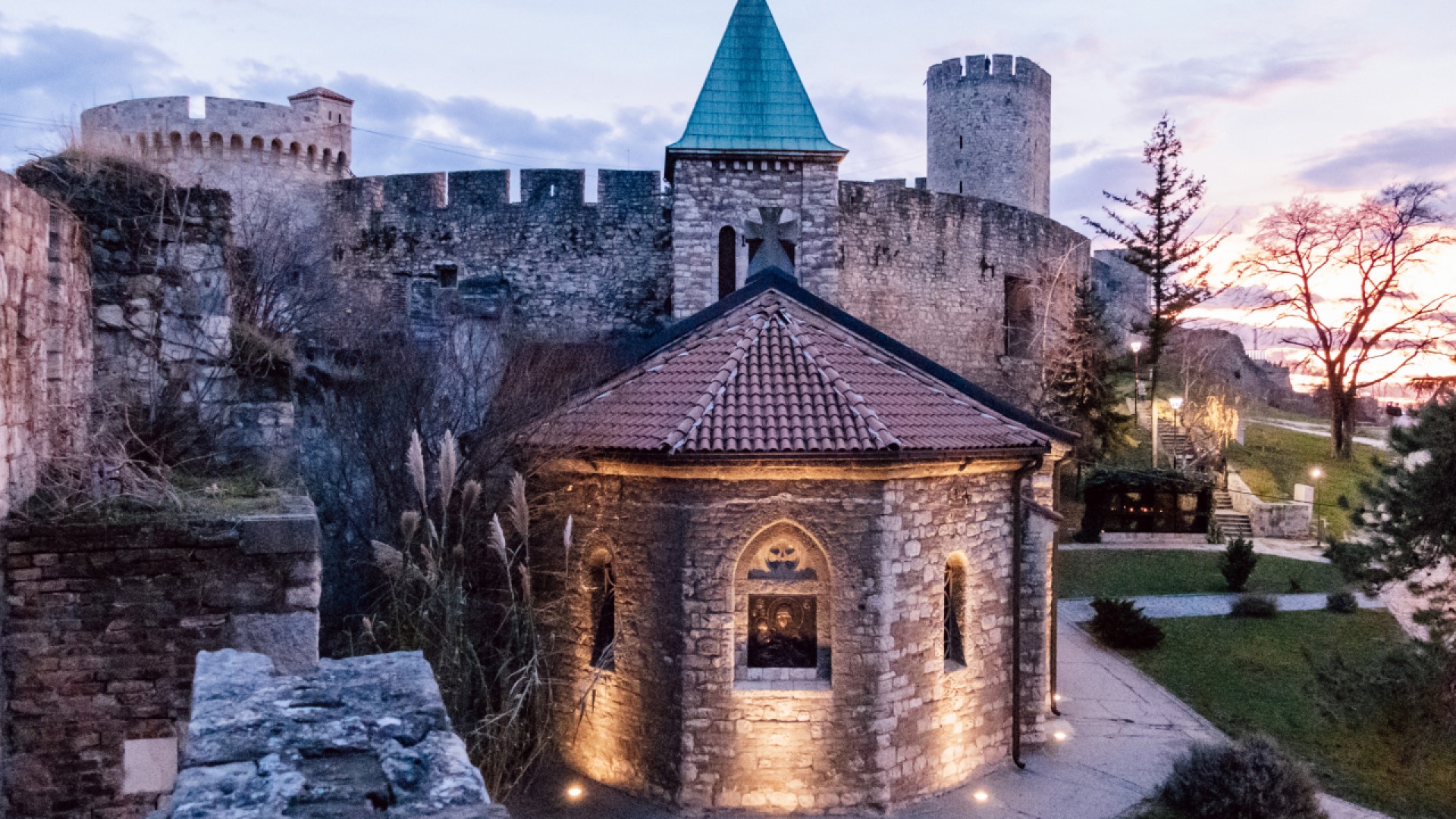
Stop 7. Ružica Church in Belgrade Fortress (renovation 1925)
The finale of the route is the Ružica Church in Kalemegdan. The place dictates the tone: a fortress is always about the multilayeredness of power, multiple empires in one stone. Ksenija Golubović, in her book The Russian Daughter of a Serbian Writer, writes the following about Kalemegdan Fortress:
"Indeed, the fortress we wander through is layered, like the very history of the Balkans. It begins with a Roman layer, onto which a Turkish layer is superimposed, then an Austro-Hungarian layer: where stone is there — Austria-Hungary, where brick—the Turks, the clear fortification lines are adorned with semicircular minarets, shell-loop-holes. Here, a gate was built by the Romans, here—a passage and gate—by the Turks, here—by the Austro-Hungarians. Types of power succeed each other in the same structure, creating a peculiar unity <...>."
And the Ružica church is part of this eclectic biography.
An old church existed here during the time of Despot Stefan Lazarević but was destroyed by the Turks when they captured Belgrade in 1521. In the 18th century, a gunpowder warehouse stood on the site of the church, and in the second half of the 19th century, after the fortress came under Serbian control, the space was converted into a church and named Ružica, in memory of a medieval church of the same name. At the end of the 19th century, the church was used as a garrison church.
After severe damage in World War I, the church was renovated and restored in 1925. The reconstruction is associated with the name of Nikolai Krasnov—and here it is important how exactly he worked with the past he inherited. He preserved the spatial solution and dimensions but deliberately emphasized the archaic and fortress environment: instead of "solemnity," he brought to the fore the unplastered texture, the rough, unfinished stone—so that everyone entering here would know for certain the historical place they have the opportunity to encounter.
The church plan is elongated, with an altar apse in the east and a massive bell tower in the west, adjoining the fortress walls. The iconostasis was made by the artist-monk Rafailo Momčilović, and the wall paintings are the work of Russian artist Andrei Bitsenko. The frescoes stand out because, besides canonical scenes, they include compositions with portraits of Serbian rulers and many contemporaries—meaning the church records not only sacred history but also earthly, national history.
In front of the entrance, during the 1924 reconstruction, two bronze sculptures of Serbian soldiers were installed—a medieval knight and a World War I soldier. And this is a very characteristic gesture for the national myth of royal Yugoslavia: placing two eras, two important historical points in parallel—and making them guardians of the church.
And now—that powerful image which many remember for a lifetime: the chandeliers made from shell casings and weapons parts from World War I. It seems nothing more precise could be devised for the 20th century: that which killed, begins to illuminate. That which was the iron of death, becomes the iron of faith.
In the magazine Serb about Russians, there is a remarkable quote:
"What did the Russians give us? Russian ballet, Russian salad, Russian balalaika, Russian cigarette cases made of Russian platinum, Russian aristocrats, Russian icons, and the custom of kissing women's hands. What did the Russians take from us? Rakija, the ability to curse, civil service with some kind of salary, and those who married our girls—also a dowry."
The route we have taken testifies that the Russians gave the Serbs a part of their sacred architecture.
And so we have come to the end—from the intimate Church of the Archangel Gabriel to Ružica. Throughout this journey, we have seen how Belgrade inscribes the sacred as part of its urban logic: sometimes through a monument in stone, sometimes through the memory of exile, sometimes through translating a lost shrine into a new language.
Today's route is a story about how architecture can hold what human life can barely hold: gratitude, mourning, hope, a sense of community, and a connection to one's own roots. And if for Eliade the "center of the world" is the meeting point of heaven and earth, then for Belgrade, there are many such centers: they are scattered throughout the city, and each of them says: architecture is also a way of experiencing existential anxieties for oneself and one's people.
Route points
The Church of the Archangel Gabriel
The Church of the Archangel Gabriel, built in 1939, harmoniously combines national traditions, Byzantine forms, and modern architectural ideas.
Start
ул. Хумска, 26, Белград
The Church of Saint George on Banovo Brdo
This church carefully brings together family memory, émigré craftsmanship, and Belgrade’s architectural tradition. Its architecture combines a cruciform plan, an expressive apse, a wooden iconostasis, and unique icons.
4.7 km
46 min
ул. Кировљева, 1, Белград
The Monastery of the Presentation of the Most Holy Theotokos — Vavedenje
An outstanding spiritual centre of the Russian emigration: a five-domed church inspired by Serbian-Byzantine architecture, with a harmonious stepped composition, restrained decoration, and a solemn western portal.
3.2 km
48 min
ул. Љубе Јовановића, 8, Белград
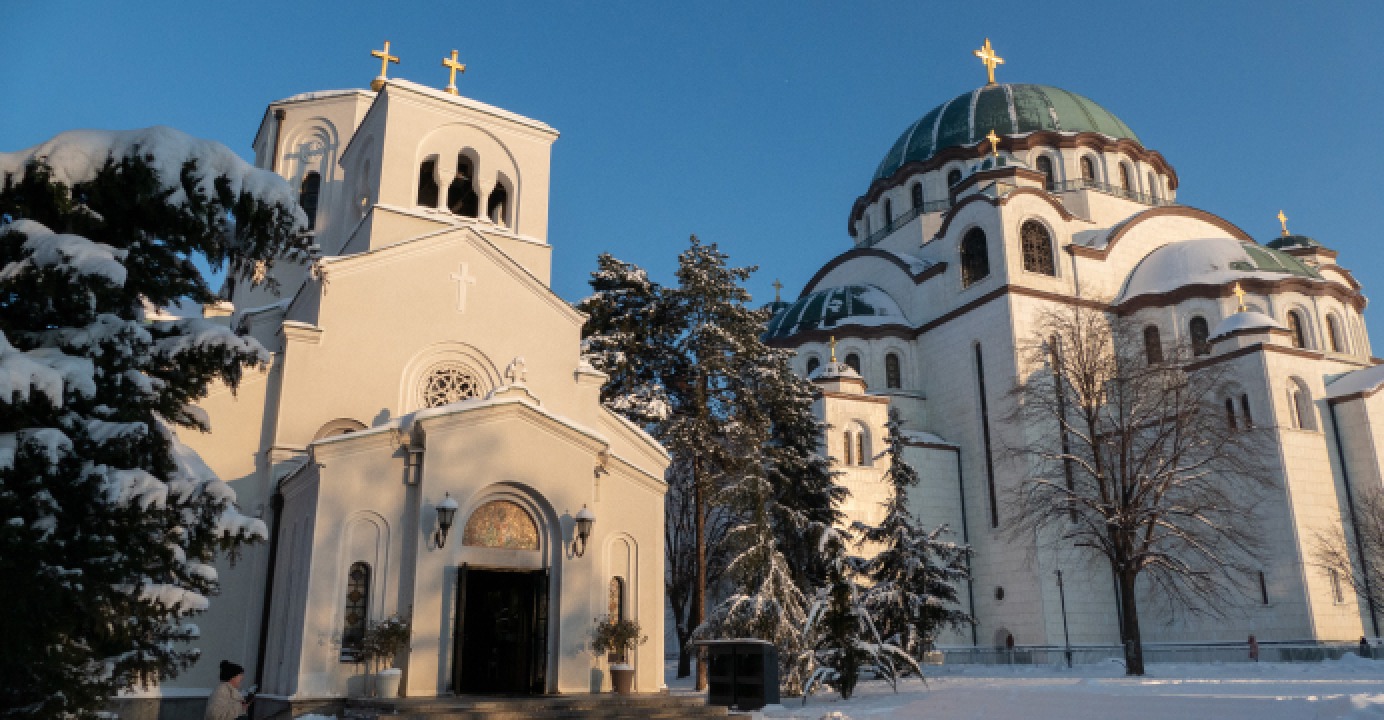
The Small Church of Saint Sava on Vračar
The Small Church of Saint Sava combines cubic forms, Byzantine motifs, and the restrained monumentality of its façade.
2.7 km
26 min
ул. Крушедолска, 2, Белград
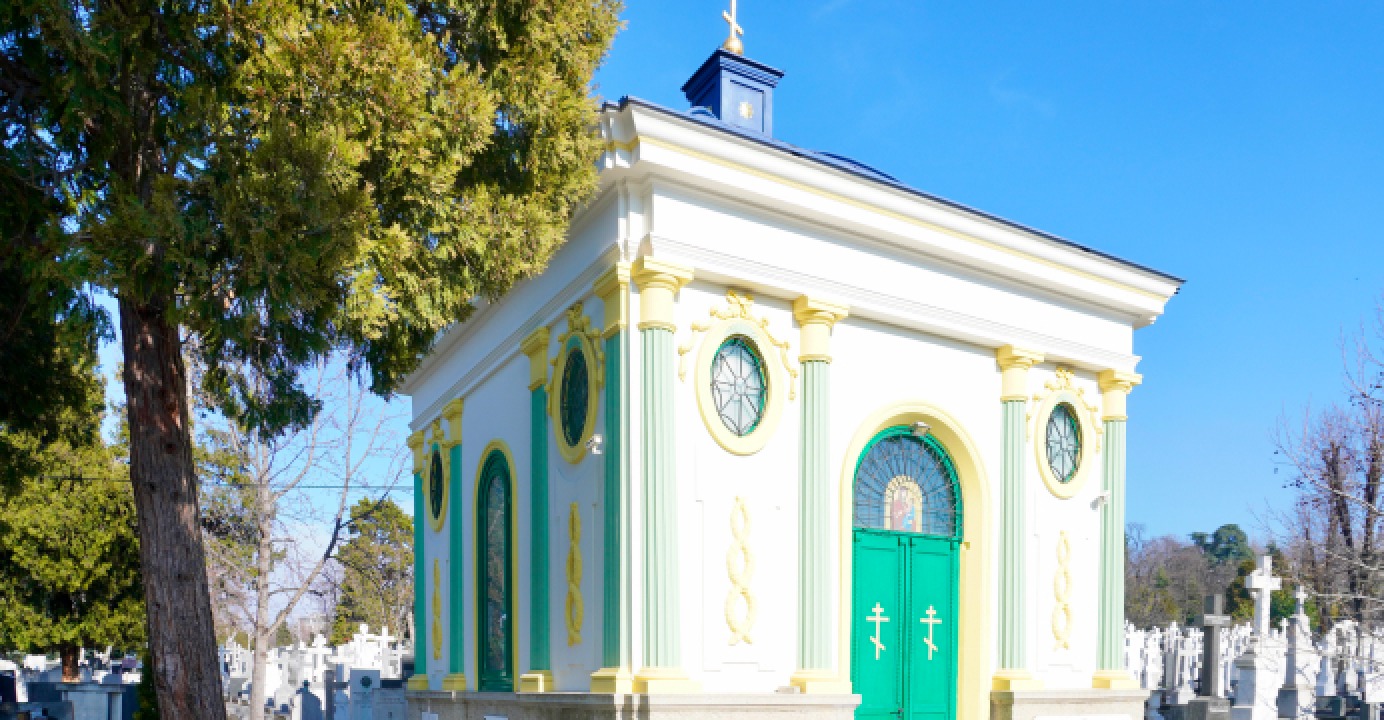
The Iveron Chapel at the New Cemetery
The Iveron Chapel is a white-and-blue monument to a lost homeland, built as a symbol of conciliarity, memory, and continuity.
2.7 km
32 min
округ Белград, Звездара, Новое кладбище
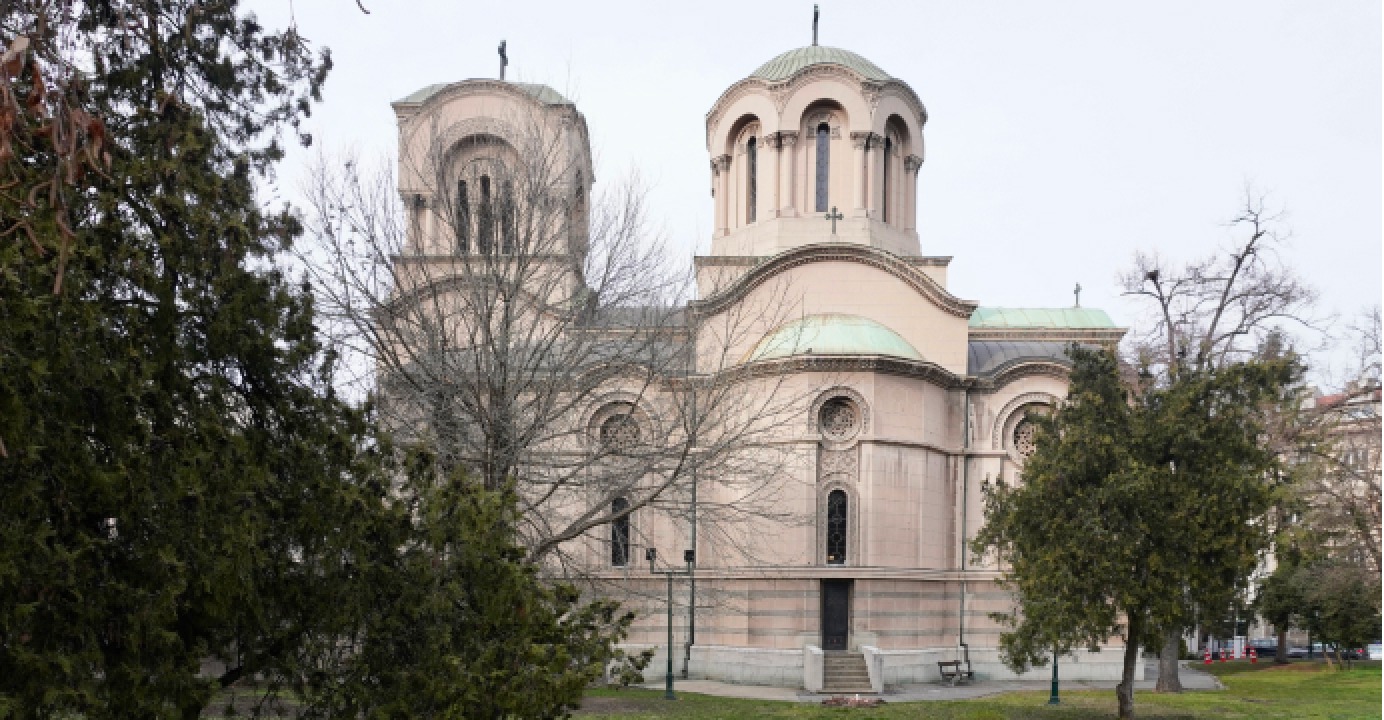
The Church of Saint Alexander Nevsky
The church, built in the style of the Morava school, embodies a Russian-Serbian spiritual dialogue, bringing together memory, history, and art. The memorial altar and monument inside symbolize the interconnected destinies of Russia and Serbia, transforming the church into a living monument of shared memory.
2.7 km
24 min
ул. Царя Душана, 63, городской квартал Дорчол, Старый Город, округ Белград
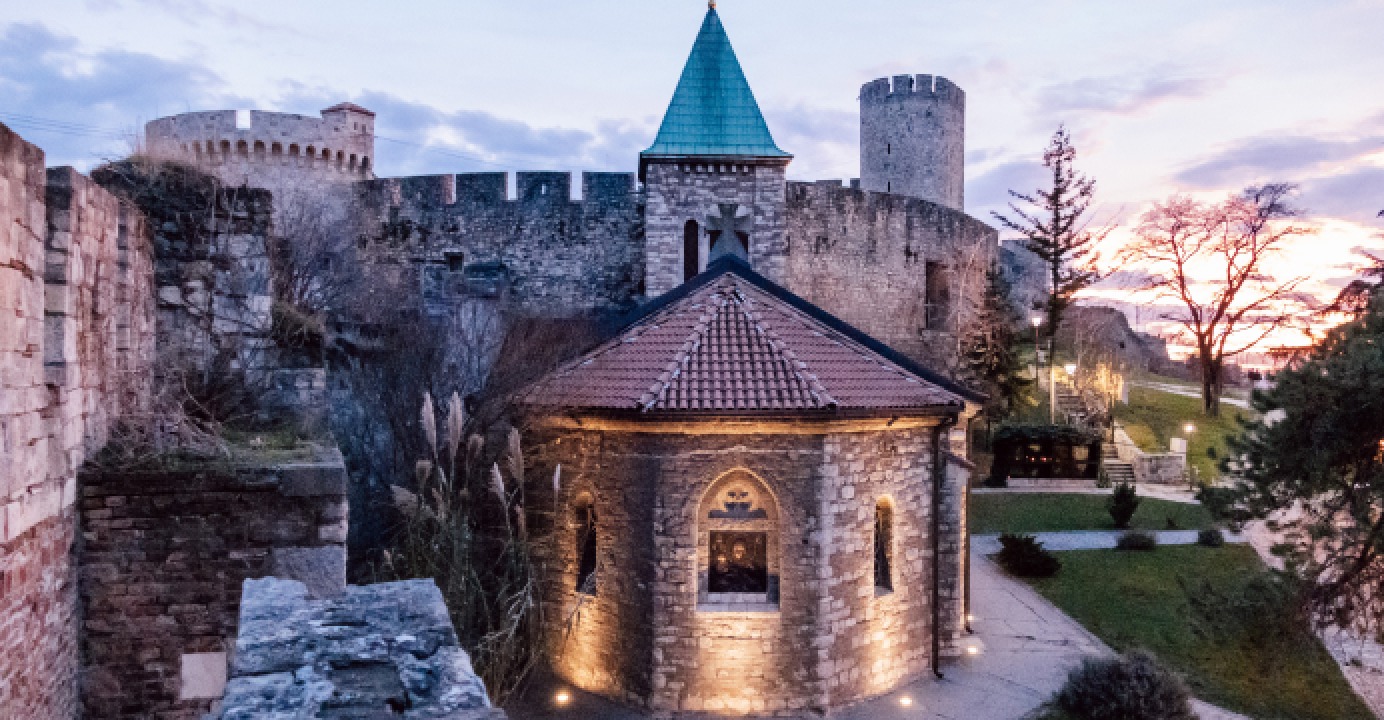
Ružica Church in the Belgrade Fortress
Ružica Church on Kalemegdan is a living monument of history, linking the layers of past years with contemporary Serbian memory. The unique texture of untreated stone, the bronze warriors, and the chandeliers made of weapons create an atmosphere of deep national memory and hope.
1.5 km
17 min
округ Белград, Старый Город, Дони град, 1
Architects
Those who shaped the look of the route's points,
learn their biographies and contribution to the face of the city.