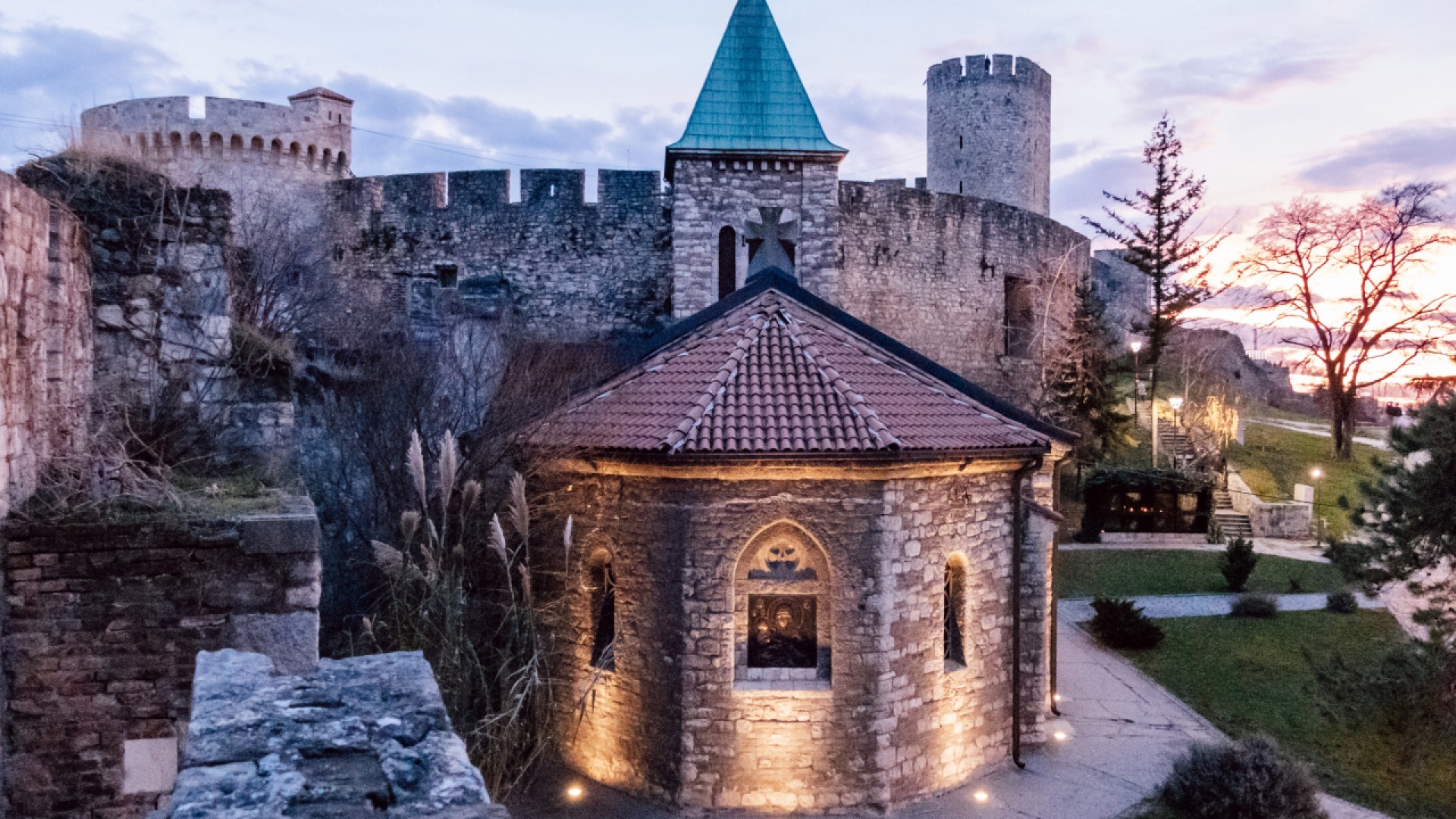
Ružica Church in the Belgrade Fortress
Ružica Church on Kalemegdan is a living monument of history, linking the layers of past years with contemporary Serbian memory. The unique texture of untreated stone, the bronze warriors, and the chandeliers made of weapons create an atmosphere of deep national memory and hope.
округ Белград, Старый Город, Дони град, 1
The final point of our route is Ružica Church on Kalemegdan. The place itself dictates the tone: a fortress is always a multilayered structure of power, a multitude of empires contained in a single stone. In her book The Russian Daughter of an English Writer. Serbian Parables, Ksenia Golubović writes the following about the Kalemegdan Fortress: “Indeed, the fortress through which we wander is layered like the history of the Balkans itself. It begins with the Roman layer; upon it lies the Turkish layer, then the Austro-Hungarian one: where there is stone, there is Austria-Hungary; where there is brick, there are the Turks. Clear fortification lines are adorned with semicircular minarets, shell-like loopholes. Here the gates were built by the Romans, here — the passage and gates — by the Turks, here — by the Austro-Hungarians. Types of power replace one another within the same structure, creating a strange unity <…>.” And Ružica Church is part of this eclectic biography.
An older church existed here as early as the time of Despot Stefan Lazarević, but it was destroyed by the Turks during the conquest of Belgrade in 1521. In the eighteenth century, a gunpowder storehouse stood on the site of the church; in the second half of the nineteenth century, after the fortress came under Serbian control, the space was converted into a church and named Ružica, in memory of the medieval church of the same name. At the end of the nineteenth century, the church was used as a garrison church.
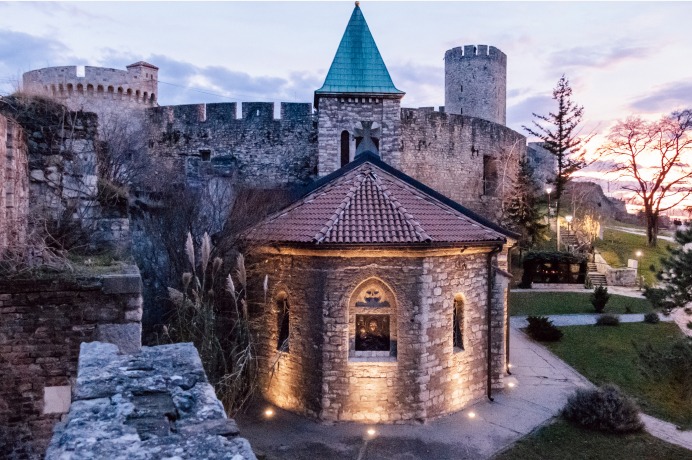
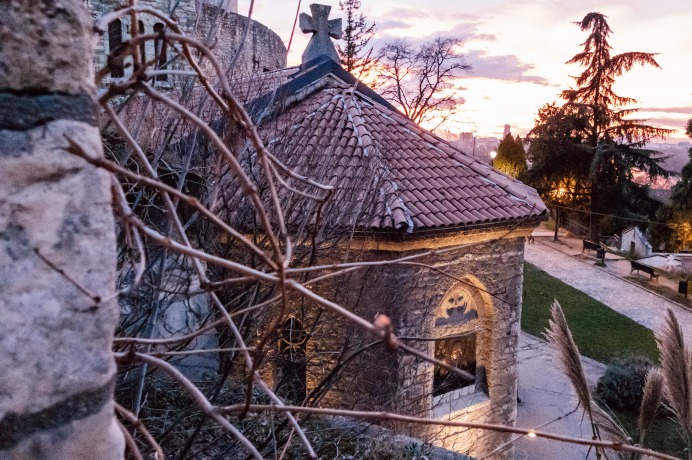
After suffering severe damage during the First World War, the church was renewed and restored in 1925. The reconstruction is associated with the name of Nikolai Krasnov — and what matters here is precisely how he works with the past entrusted to him. He preserves the spatial solution and dimensions, but consciously emphasizes the archaic character and fortress environment: instead of “ceremonial splendour,” he brings to the foreground the unplastered texture, the rough, untreated stone, so that everyone who enters may know with certainty what kind of historical place they are encountering.
The church has an elongated plan, with an altar apse to the east and a massive bell tower to the west, adjoining the fortress walls. The iconostasis was made by the painter-monk Rafailo Momčilović, while the wall paintings are the work of the Russian artist Andrei Bicenko. The frescoes are remarkable in that, alongside canonical scenes, they include compositions with portraits of Serbian rulers and many contemporaries — that is, the church records not only heavenly history, but also earthly, national history, the history of a “heavenly people.”
During the reconstruction of 1924, two bronze sculptures of Serbian warriors were placed before the entrance — a medieval knight and a soldier of the First World War. This is a highly characteristic gesture of the national myth of royal Yugoslavia: to place two epochs, two historically significant points, in parallel and make them guardians of the church.
And now, the powerful image that many remember for a lifetime: chandeliers made of shell casings and weapon parts from the First World War. It seems almost impossible to invent anything more precise about the twentieth century: what once killed now begins to illuminate. What was once the iron of death becomes the iron of faith.
In the journal A Serb on the Russians, there is a wonderful quotation: “What did the Russians give us? Russian ballet, Russian salad, the Russian balalaika, Russian cigarette cases made of Russian platinum, Russian aristocrats, Russian icons, and the custom of kissing women’s hands. What did the Russians take from us? Rakija, the ability to swear, civil service with some kind of salary, and those who married our girls — a dowry as well.” The route we have followed bears witness to the fact that the Russians also gave the Serbs part of their sacred architecture.
And so we have reached the end — from the intimate Church of the Archangel Gabriel to Ružica. During this journey, we have seen how Belgrade inscribes the sacred into its urban logic: sometimes through a monument in stone, sometimes through the memory of exile, sometimes through the translation of a lost shrine into a new language.
Today’s route is a story about how architecture can hold on to what human life struggles to preserve: gratitude, mourning, hope, a sense of community, and a connection with one’s own roots. And if, for Eliade, the “centre of the world” is the point where heaven and earth meet, then Belgrade has many such centres: they are scattered throughout the city, and each of them says that architecture is still capable of empathizing with existential anxieties for oneself and for one’s people.
Architects
Nikolai Petrovich Krasnov
Routes
Holy Connections
Address
округ Белград, Старый Город, Дони град, 1