The Church of the Archangel Gabriel
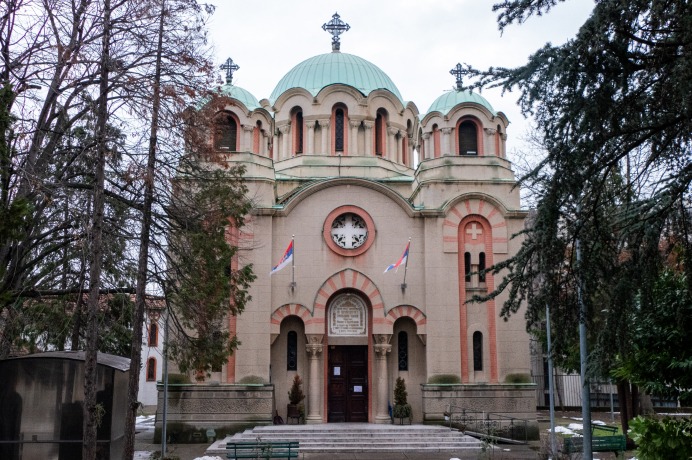
The Church of the Archangel Gabriel, built in 1939, harmoniously combines national traditions, Byzantine forms, and modern architectural ideas.
ул. Хумска, 26, Белград
The first stop on our route does not overwhelm by its scale — and that is precisely why it matters. It represents a precise gesture of an era when interwar Yugoslavia was searching for a “national style” and, in sacred architecture, sought to speak the language of continuity: from medieval Orthodox heritage toward the modern state.
Before us stands a church built in 1939 according to the design of the Russian émigré architect Grigory Samoylov.
Architecturally, it is a triconch: a plan in which the altar area and two lateral “shells” — conches — form a three-lobed scheme. In Samoylov’s work, the triconch is not so much a decorative element as the structural logic of the space: the church is perceived as a gathered, centric organism in which everything aspires toward the dome.
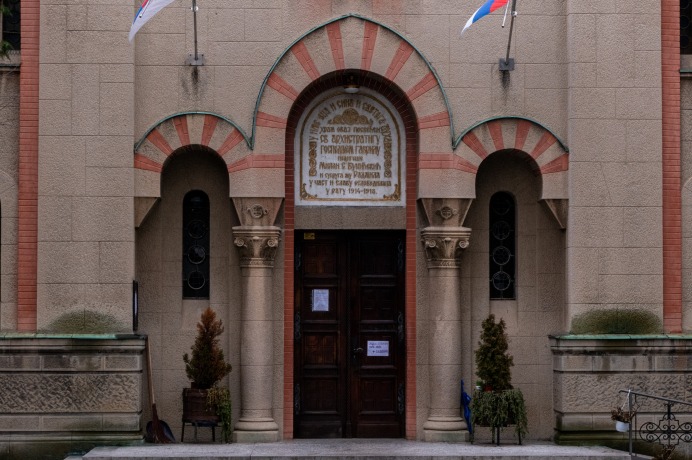
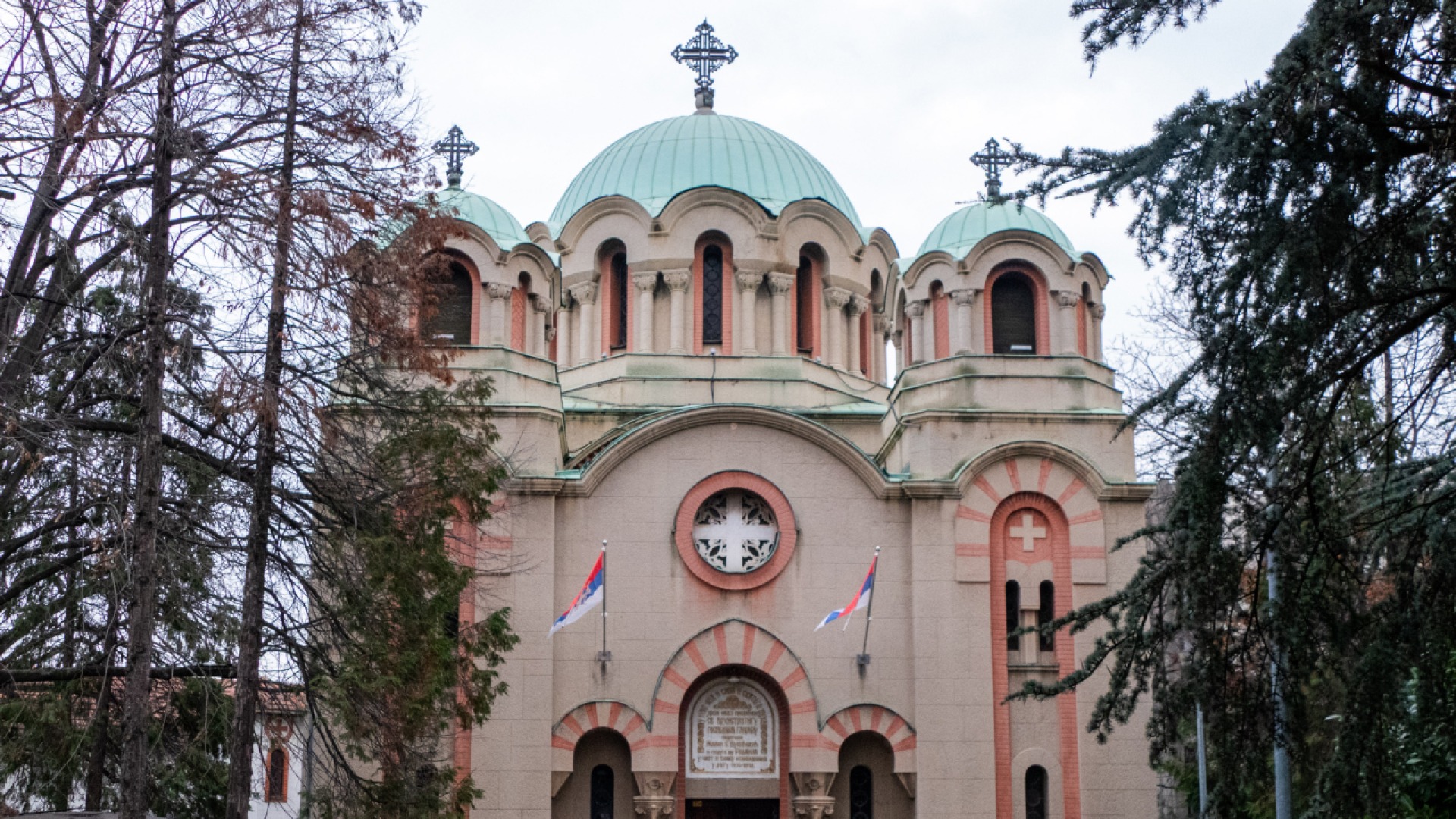
Look at the western façade: the entrance is flanked by two symmetrical bell towers — a solution that immediately creates a sense of strict verticality and solemnity. Here Samoylov combines monumentality with “legibility”: you do not get lost, you do not have to search for the centre — it is marked by the body of the building itself and is understood intuitively.
An important detail is the dominant drum of the dome. It does not dissolve into the whole, but functions as an architectural accent, as the “voice” of the building.
At the same time, the church does not feel heavy: the drum is pierced by narrow window openings, and the light gathers the space together.
Another expressive detail: in Samoylov’s work, “Byzantineness” does not become an act of restoring museum heritage. It is emphasized, for instance, by the massive semi-domes of the lateral conches and the distinctive arch above the portal — researchers note the horseshoe-like character of this arch as an important element of the building’s image.
What stands before us is not a reconstruction of “how it once was,” but a modern interpretation, a careful rethinking of uniqueness — above all, an attempt to pay tribute to tradition, rather than blindly imitate it.
And here is something especially rewarding for the attentive listener: Samoylov designed the church as an integral whole, thinking not only about the walls, but also about its inner “matter” — the iconostasis, the details, and the decorative work. The interior is noted for carved capitals with small figures of birds, stained-glass windows depicting animals, and a mosaic floor.
Now we move on — toward a church where the Russian émigré line manifests itself in a different way.