Imperial
We begin our route at the place where this language of power acquired its material form
5 Points
47 min
4.7 km
Audio guide
Stop 1. The Assembly Building – National Assembly of Serbia
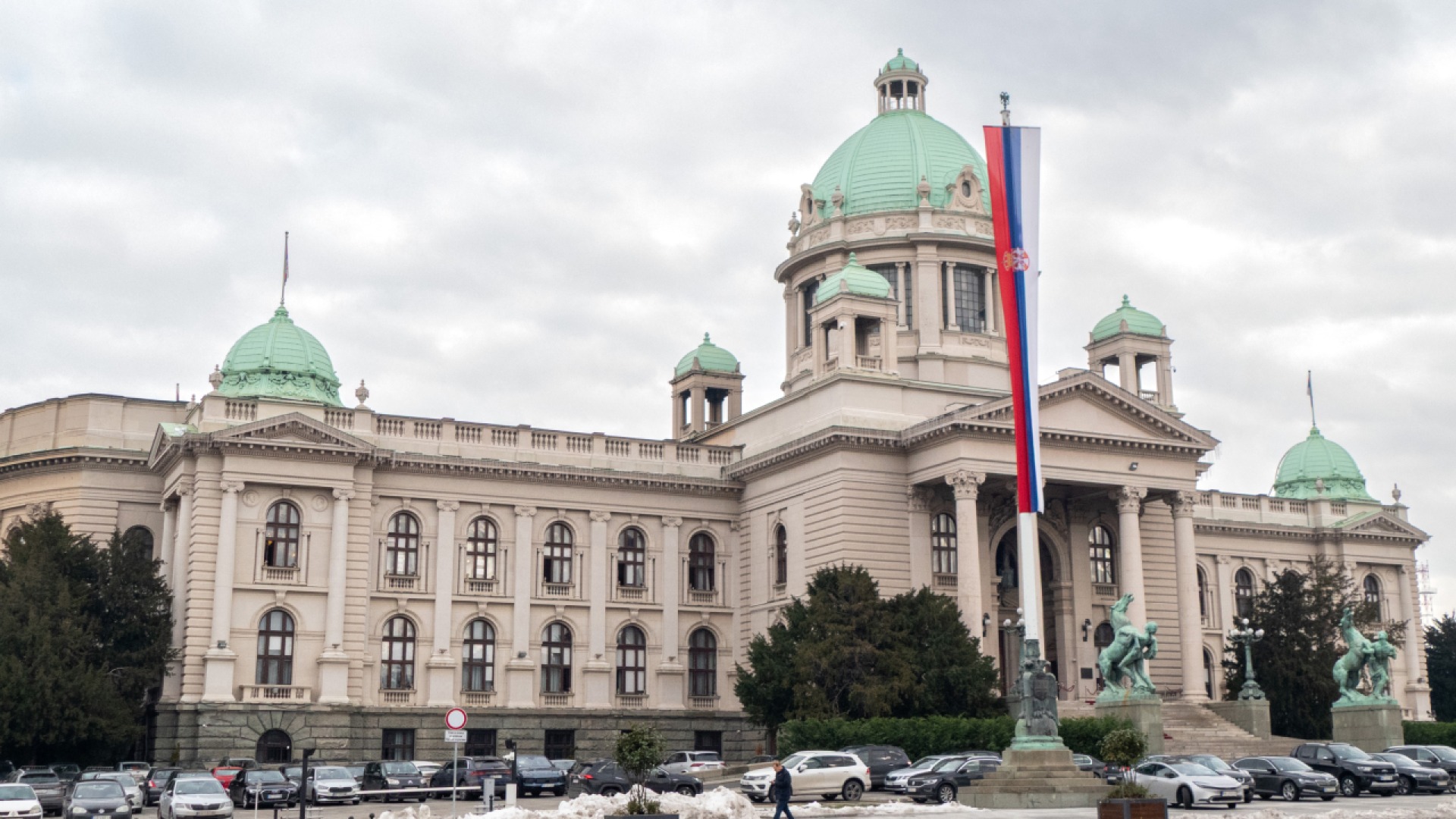
We begin our route where this language of power took on material form. Before us stands the National Assembly, one of Belgrade’s most recognizable symbols and an imprint of the era when Yugoslav statehood was taking shape.
We are standing in Nikola Pašić Square. The construction of the building took almost thirty years, from 1907 to 1936. Its story began as early as 1892, when the architect Konstantin Jovanović proposed the design of a representative “palace of politics” for a unicameral parliament. After its difficult struggle for independence, Belgrade needed a monumental building symbolizing metropolitan status and autonomy. But at the beginning of the twentieth century, a new constitution changed the political system: parliament became bicameral, a senate appeared, and the old design no longer matched the new reality.
In 1902, a competition was announced. The winner was the Serbian architect Jovan Ilkić. He took Jovanović’s idea as a basis and reworked it, creating the design for the “House of National Representation” – a building intended to bring under one roof the National Assembly, the Senate, the State Council, and numerous service rooms. In 1907, under King Peter I Karađorđević, the foundation stone was ceremonially laid. It seemed that everything was only just beginning.
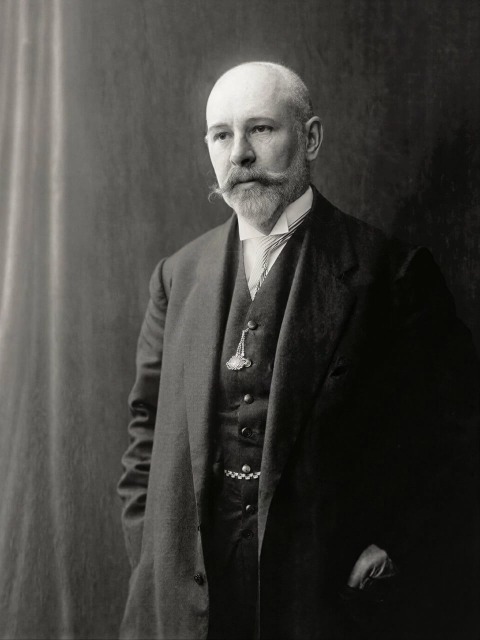
History has repeatedly shown that violence becomes a catalyst for major historical shifts. The Balkan Wars and the bloodshed of the First World War interrupted construction: work stopped and resumed, only to freeze again for many years. Only in the mid-1930s did the project enter its final stretch. From 1934 onward, construction was headed by Nikolai Petrovich Krasnov, a Russian émigré, former architect of the imperial court, academician of architecture, and designer of the Livadia Palace. After the 1917 Revolution, he found himself in Belgrade and became an architect for the Ministry of Construction. It was he, a Russian, who was destined to give the Assembly its finished form.
Krasnov did not alter the architectural foundation – its academic monumentality had already been established. Before us is a freestanding palace in the spirit of the Italian Renaissance: a central portico with a triangular pediment, Corinthian columns, a powerful dome with a lantern, four small corner domes, and the strict symmetry of the façade. The central staircase rises like a ritual path, symbolizing hierarchy and state power.
But the most important thing Krasnov did was create the building’s inner world. The interiors were thought through down to the smallest detail: doors, chandeliers, lamps, furniture, decorative elements, even the fence around the park – everything was designed in a single stylistic language.
Inside there is a ceremonial vestibule beneath the dome, polychrome walls, a marble floor, coats of arms, and sculptures of rulers. The large assembly hall, paneled in walnut wood, with rich stucco decoration and furnishings, was designed first for 200 and later for 400 deputies. In the left wing is the Senate chamber. Two symmetrical staircases of white marble are adorned with bronze allegories of justice and enlightenment. In 1937, the walls were decorated with twenty frescoes by outstanding Yugoslav artists. Among the sculptures are an allegory of seafaring and fishing by Petar Pallavicini and a figure of Tsar Dušan by Dragutin Filipović.
On the façade are medallions with Athena and figures of Pericles, Demosthenes, and Cicero by the sculptor Đorđe Jovanović – a gesture toward Antiquity. At the portals stands an angel with a torch and an olive branch, conceived by Petar Pallavicini. And before the main entrance, since 1939, stand Toma Rosandić’s bronze “Playful Black Horses” – horses frozen in motion that make even a passerby stop and look at their grace and strength.
The site on which the Assembly stands is also interesting in itself. Before construction began, this was the location of the so-called Batal Mosque, one of Belgrade’s most beautiful Ottoman mosques. In 1830, the Great National Assembly was held here, where the sultan’s hatt-i sharif on the rights of the Serbs was read aloud and Miloš Obrenović’s right to hereditary rule was confirmed. The mosque was later demolished, but its memory lived on for a long time in the name of the neighborhood. The building was solemnly consecrated on October 18, 1936, in the presence of King Peter II. The very next day, the first session was held here – and almost immediately a new political whirlpool began. The parliament of the Kingdom of Yugoslavia remained in this building for only three years.
In April 1941, Belgrade was bombed, yet the Assembly was scarcely damaged – its architectural shell endured while the state itself was destroyed. After the country’s capitulation, the building entered the space of occupation power: the civil administration was housed here. There is an almost ironic historical paradox in this: a symbol of Yugoslav sovereignty became embedded in the infrastructure of external control.
At the same time, however, alongside the functioning of the occupation apparatus, a powerful resistance movement unfolded in the country – the partisan struggle, which gradually formed an alternative source of legitimacy. Thus, during the war years, the Assembly building found itself in a dual historical perspective: physically it served the occupation order, yet symbolically it was already becoming the future stage of a new government born in struggle.
After the liberation of Belgrade, the organs of the new socialist government were housed here. It was in this building that the Federal People’s Republic of Yugoslavia, and later the Socialist Federal Republic of Yugoslavia, was proclaimed. Constitutions were adopted here, key political sessions were held here, including the 1961 conference of the Non-Aligned Movement, which cemented the country’s special international position. Here too, in 1980, the country bid farewell to Josip Broz Tito – the leader of Yugoslavia whose figure largely determined the state’s political trajectory in the second half of the twentieth century.
Today the National Assembly remains the parliament of Serbia and has had the status of a cultural monument since 1984. It stands amid the New and Old Palaces, the Historical Museum of Serbia, the Main Post Office, and Pioneer Park – in the very heart of administrative Belgrade.
But the Assembly, while being a cultural monument, has also been a place where history is made: on October 5, 2000, parliament became one of the protesters’ main symbolic targets. As the scholar Aleida Assmann writes in the book History’s Disappearance – History’s Obsession: “Vandalism is a symbolic and demonstrative form of crushing the opponent by destroying his cultural heritage.” During the mass demonstrations against Slobodan Milošević’s regime, protesters stormed the Assembly building, set it on fire, and partially wrecked its interiors – an act of dismantling the regime. The seizure of parliament signaled the loss of legitimacy of the ruling authorities: in revolutionary practice, taking control of government buildings signifies the transfer of control over the state. Thus, a building conceived as an architectural embodiment of state stability and parliamentarism became, in 2000, the stage for a public break with the previous political order.
Stop 2. Archives of Serbia
Now we have reached a building that does not merely store documents, but preserves the state’s DNA. The Archives of Serbia were built specifically for their function – a rare case in interwar Belgrade. The building was erected in 1928 to a design by the now familiar Nikolai Petrovich Krasnov. Krasnov began work on the project in 1925. Just three years later, the building was complete.
Architecturally, the Archives building is one of the most refined examples of academism in modern Serbian architecture. It is two stories high and, in plan, resembles an inverted letter T: the transverse wing faces Karnegijeva Street, while the longitudinal wing extends deep into the courtyard. This layout was conceived functionally. In the formal street-facing block, Krasnov placed the working and administrative rooms, while the longitudinal part housed the repositories. In other words, everything connected with the institution’s daily life faces the city, while everything connected with the preservation of memory is hidden inside, protected and removed from street bustle and modernity.
Krasnov had experience in representing power – one need only recall his projects in his homeland, such as the Livadia Palace, or the interiors of the National Assembly. But here he chose a different way of communicating with the world through architecture. The Archives were not meant to impress with monumentality; they were meant to inspire trust – in memory and in history.
Today, passing by and taking the urban landscape for granted, it is easy not to notice this restrained severity. But if you stop and look closely, it becomes clear: before us is a building in which architecture serves memory.
Stop 3. Main Post Office and the Constitutional Court of Serbia
At last, we have reached a building with “two faces” – the Main Post Office and the Constitutional Court of Serbia. In Belgrade, the repurposing of a building – and with it the radical reshaping of its identity – is an everyday matter. Before us is one of Belgrade’s most recognizable, and also one of its heaviest and most massive, buildings. The Main Post Office, on the corner of King Alexander Boulevard and Takovska Street, is hard to miss: it seems to grow into the intersection and set its scale. Massive, austere, and emphatically monumental, it has long been part of the cityscape – both for Belgraders and for visitors to the capital.
The building was erected in the late 1930s to a design by the Russian émigré architect Vasily Androsov. Its silhouette is sometimes compared to examples of German architecture of the same period – an association born more from the shared language of 1930s monumentality than from direct influence. Before us is a specimen of late interwar academism: strict symmetry, heavy volumes, and a large scale intended to make the building look like a state institution.
But the history of this site began long before the post office appeared. As early as 1921, a far more ambitious project was being discussed here on Tašmajdan – the construction of a new multi-level railway station. Trains were supposed to disappear underground, pass through tunnels, and only then emerge to the surface. For the young country, the idea proved too expensive – the estimate reached one billion dinars. Yet the concept itself was ahead of its time: the tunnel under Terazije, conceived then, was realized only in the socialist period.
The station project also included a post office building – and it was this that was ultimately chosen for construction. At first, the competition was won by the young Croatian architect Josip Pičman. However, King Alexander Karađorđević personally rejected his design, and the commission was handed to Androsov. The king did not live to see the building completed – he was assassinated in Marseille in 1934. And in 1936, Pičman took his own life; according to one version, the tragedy was linked to the failure of the Belgrade project, according to another, to the difficulties of constructing a skyscraper in Rijeka. Creative people are prone to impulsive acts; in the final part of our route, we will once again have to return to this theme.
But for now, not about that, but about the Main Post Office building. The building’s southern wing, facing King Alexander Boulevard, was originally intended for the Poštanska štedionica bank. In the 1940s, the National Bank of Serbia moved here, and since 2013 the Constitutional Court has been located here.
The wartime history of the building is no less dramatic. In the spring of 1941, after the Wehrmacht invasion and the creation of puppet regimes, the consulate of the Independent State of Croatia was housed in the Main Post Office. The consul was first Josip Lančarević, then Ante Nikšić. A year later the consulate moved to Dorćol, but it was here that this chapter of occupation history began. A curious and grim fact: despite the brutality of the NDH regime, during the entire existence of its consulate in Belgrade not a single action against its representation was recorded.
As we were walking, did you notice the traffic light? Interestingly, it was exactly at this intersection that Belgrade’s first traffic light appeared, in 1939. By then the city already had more than 400,000 inhabitants: trams and buses ran through the streets, carts and automobiles rattled by, but there was still no electric traffic controller. The corner of Takovska, King Alexander, and what was then King Ferdinand Street became a symbol of modernization. By 1957, the city had only sixteen traffic lights – they would become widespread only in the 1960s.
Stop 4. Patriarchate of the Serbian Orthodox Church
Now we make a leap from the secular and everyday to the sacred. The building of the Serbian Patriarchate was erected in 1933–1935 to a design by the Russian architect Viktor Viktorovich Lukomsky on the site of the former metropolitan’s residence of 1863. Lukomsky belonged to the so-called “middle generation” of Russian émigré architects who established their professional careers precisely in the Kingdom of Serbs, Croats and Slovenes / Yugoslavia; a graduate of the Nikolaev Military Engineering Academy, he came to Belgrade in 1920 and became part of the wave of Russian architects that noticeably transformed the capital’s architectural appearance.
The purpose of the building predetermined its style. Lukomsky turned to the Serbo-Byzantine tradition, but did not copy it literally, instead seeking to reinterpret it while preserving its ideological core. What we see is a modernized, authorial version of a historical language. Stylized columns, biforas, medallions, consoles, and arched openings – all of this is a free interpretation in which one senses the hand of a master accustomed to thinking in large forms and clear composition.
The main entrance is especially expressive. It is accentuated by massive engaged columns and crowned with the patriarchal coat of arms. Above the portal is a mosaic of Saint John the Baptist, created from a sketch by the émigré artist Vladimir Predaevich. This image is not accidental: Saint John was regarded as the heavenly patron of the family of Patriarch Varnava, a bishop of the Serbian Orthodox Church.
If you go inside, the space continues the same idea. The first-floor interior, with its arcade of semicircular arches on columns and capitals, refers back to Byzantine artistic experience. There is no excessive splendor here – monumentality is achieved through rhythm, proportion, and the calm of the lines. The complex includes the court chapel dedicated to Saint Simeon the Myrrh-Streaming, the Patriarchate Library, and the Museum of the Serbian Orthodox Church.
Lukomsky’s fate was not an easy one. After the war, his situation was difficult; archival documents record the material hardships and losses of his final years. But the Patriarchate still stands, which means that Viktor Lukomsky has forever been inscribed into the history of the city to which he devoted most of his life.
And now we invite you to the final point of our route.
Stop 5. Branko’s Bridge
And now, at last, we are at Branko’s Bridge – one of the main crossings over the Sava – but its story begins under another name. It was once known as the Zemun Bridge, and later as the King Alexander I Bridge. It was built from 1929 to 1934. The bridge was meant to connect more than just the two banks of the river. It linked Belgrade with Zemun – a former city of the Habsburg Monarchy. For centuries these territories had stood on opposite sides of political and cultural borders. The new bridge was conceived as a symbol of unification – literally and metaphorically.
The engineering structure was complemented by architectural elements that gave the bridge representational force and symbolic weight. The five massive river piers supporting the metal superstructure were designed by an old acquaintance of ours, the Russian émigré architect Nikolai Nikolaevich Krasnov.
The architectural language of these piers was not chosen by chance. Contemporaries called it “Romano-Byzantine” – an eclectic yet expressive combination of Romanesque and Byzantine motifs. The stone plasticity lent the industrial structure historical depth and connected it to the traditions of the region’s medieval architecture.
At the end of 1933, the city authorities decided to strengthen the bridge’s artistic image. The idea arose of decorating the iron structure with monumental sculpture so that it would harmonize with the city’s historic center while also becoming an expressive ideological gesture. The commission was entrusted to one of the most famous sculptors of his time – Ivan Meštrović. Meštrović proposed a grandiose solution: four colossal statues, each about ten meters high. They were to be installed two on each bank – directly on Krasnov’s “Romano-Byzantine” piers. The figures were to rise on slender twin-column pedestals about twenty-two meters high. The sculptural program was carefully thought out. On the eastern bank, two medieval rulers were to be placed – King Tomislav, the first Croatian king, and Emperor Dušan, one of the most powerful Serbian rulers. They symbolized the “golden ages” of Croatian and Serbian history.
On the western bank, two more figures were to appear: the Bosnian king Tvrtko I Kotromanić and King Peter I Karađorđević – Alexander I’s father. These images joined the medieval and the modern eras, forming a pantheon of “Yugoslav” rulers. Meštrović’s project, unfortunately, remained unrealized, yet the idea itself shows how great a political and symbolic significance was attached to this bridge.
Today, walking across Branko’s Bridge, it is hard to imagine that giant riders embodying different eras and peoples might have towered above us.
The bridge also has its own history of names – no less expressive than its architecture. We touched on this a little at the beginning of our discussion. During the interwar period it bore the name of King Alexander I, but after the Second World War, in socialist Yugoslavia, it officially became the Bridge of Brotherhood and Unity – entirely in the spirit of the time.
But Belgraders rarely use official names, preferring to endow architectural objects with meanings of their own. In everyday speech, the bridge came to be called Branko’s – after Brankova Street, which leads to it. And the street itself was named after the nineteenth-century Serbian Romantic poet Branko Radičević.
In 1984, the name acquired yet another, tragic dimension. The well-known Yugoslav writer Branko Ćopić jumped from the bridge. After that, the name “Branko’s Bridge” began to be perceived ambiguously. Today many residents no longer stop to think which Branko it is named after – the nineteenth-century poet or the twentieth-century writer. It is said that Ćopić recalled his first arrival in Belgrade – how in 1936, young and unknown, he slept beneath this very bridge. At that time it was called the King Alexander Bridge – the very one destroyed during the war. He pointed to a bench under the bridge and said: “This bridge is my fate.” Since then, the bridge has acquired a sad reputation – it is called the “suicide bridge”: every year, dozens of attempts to take one’s own life take place here.
Today, to use the language of Milorad Pavić, we have begun to study the biography of Belgrade – leafing through its chronicle by way of façades and bridges, in other words, by the imprints of an era left to us by Russian architects. We began at the National Assembly; looked into the Archives of Serbia, where memory is kept; stopped at the Main Post Office and the Constitutional Court; entered the space of the Patriarchate – where the sacred proved to be closely intertwined with the modern; and ended our route on Branko’s Bridge – a symbol of the joining of banks, eras, polities, and human destinies. Before us was the living fabric of the city, carefully woven through the synergy of Russian and Serbian architects, artists, and writers. And if at the beginning of the journey we spoke of the language of power and of an imperial image, now we can add that this city has yet another dimension: the dimension of memory.
Route points
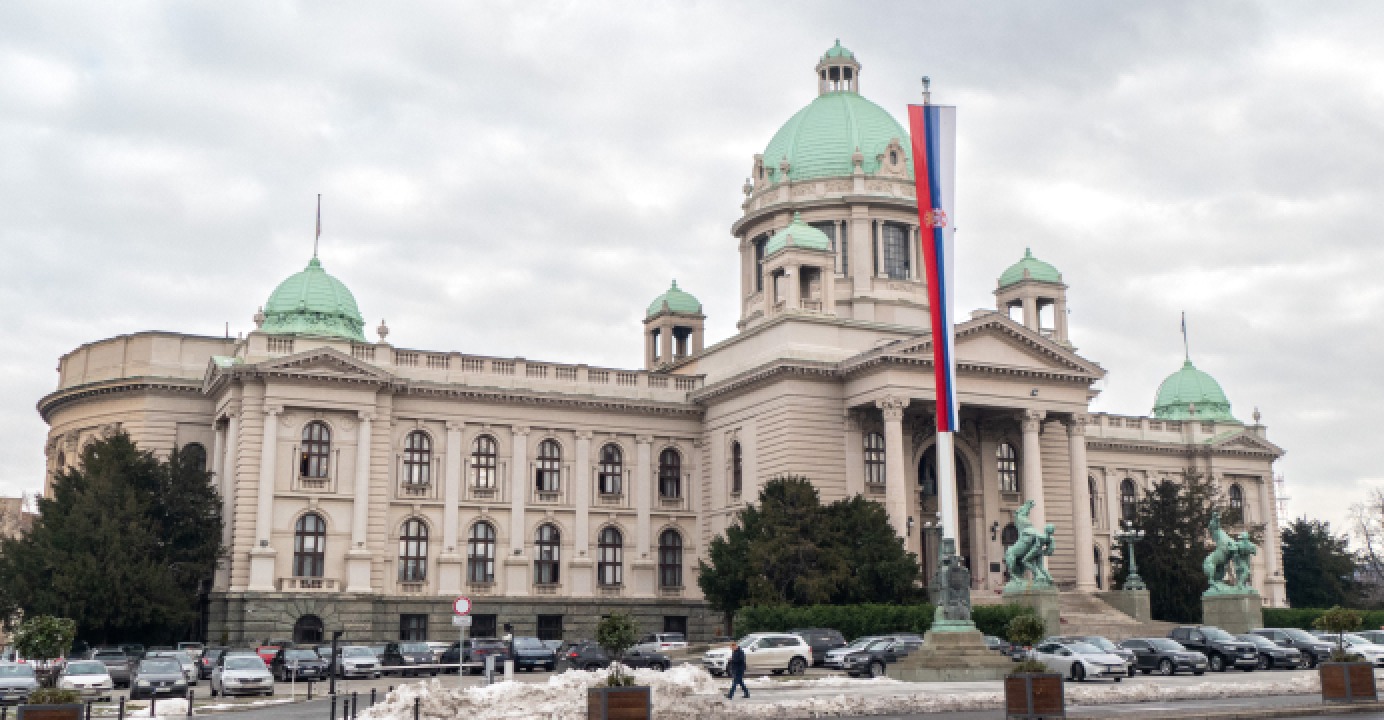
The National Assembly of Serbia
An iconic building of Belgrade, a symbol of Yugoslav statehood, built in the style of the Italian Renaissance.
Start
округ Белград, Старый Город, Трг Николе Пашича, 13
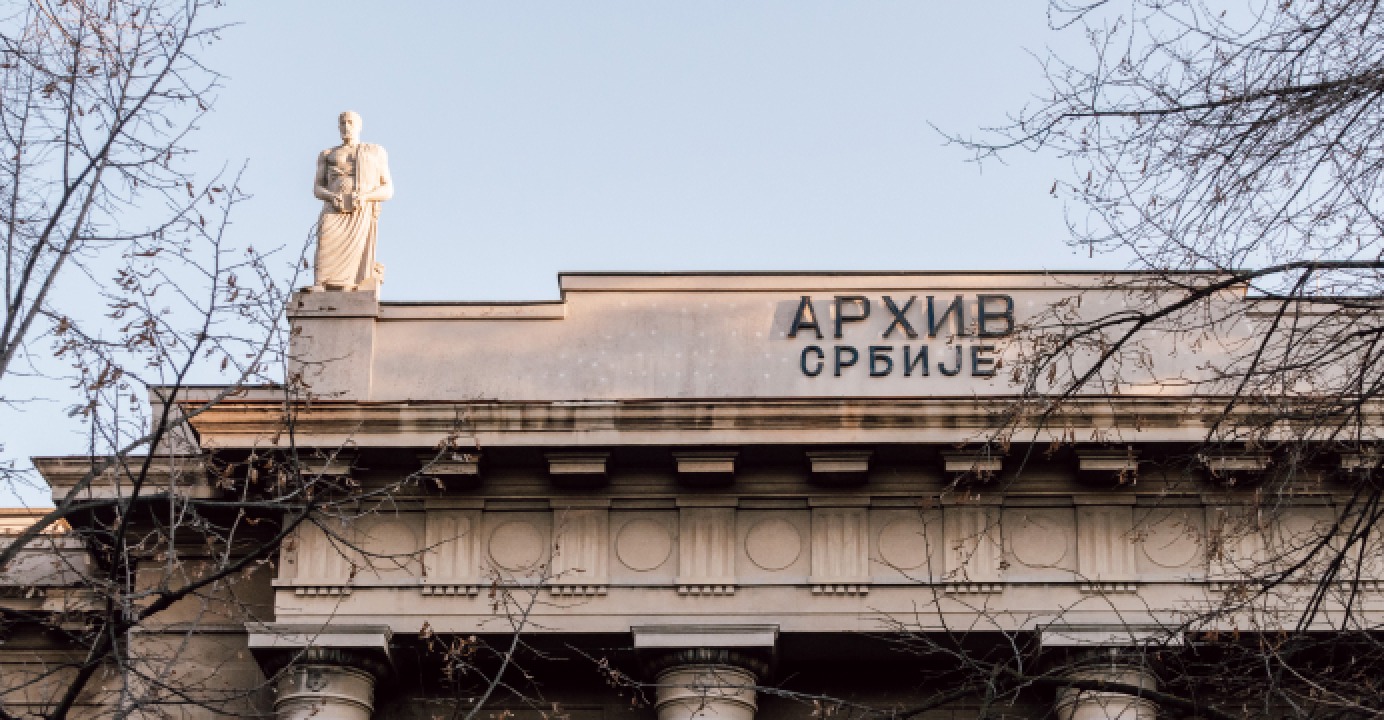
The Archives of Serbia
An example of academicism in which architecture preserves historical memory and state identity with restraint and reliability.
1.2 km
12 min
ул. Карнегиева, 2, Белград
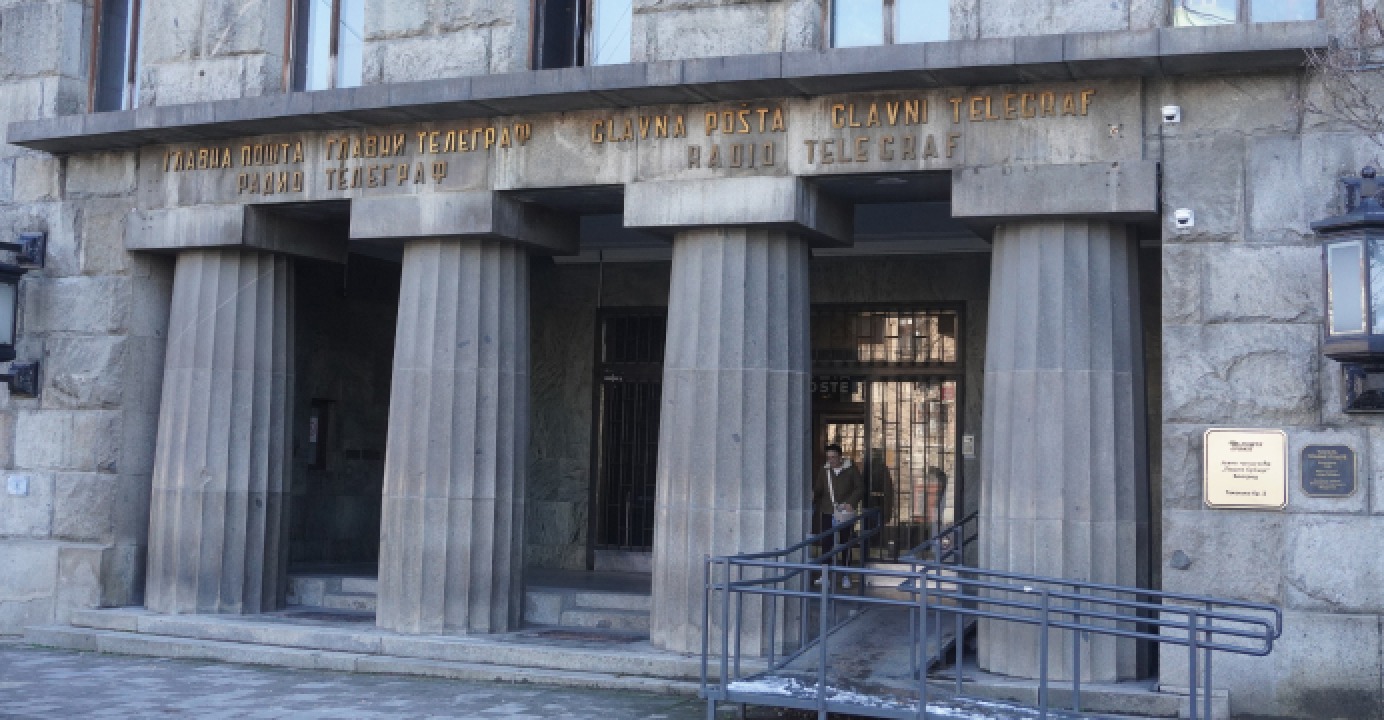
The Main Post Office and the Constitutional Court of Serbia
A monumental academicist building of the 1930s, which became a symbol of scale, urban identity, and Belgrade’s modern transformations.
1 km
12 min
бул. Короля Александра, 15, Белград
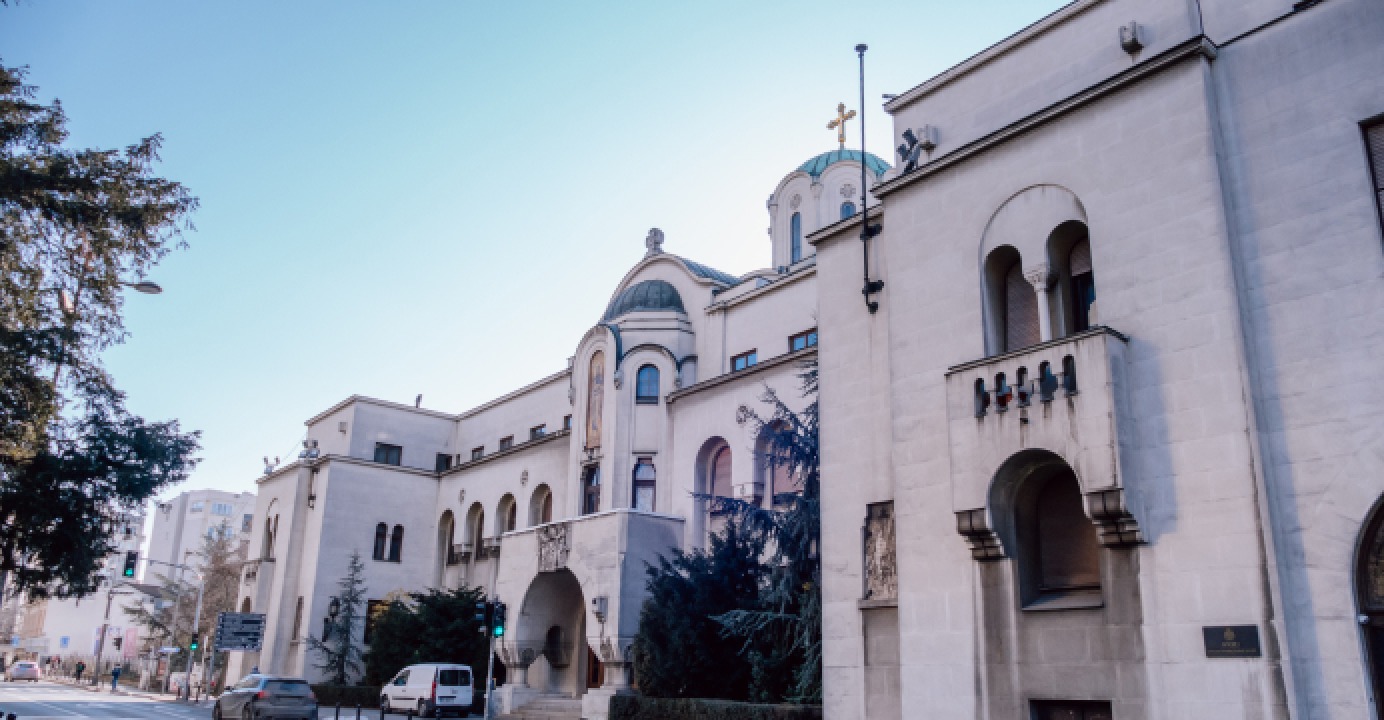
The Patriarchate of the Serbian Orthodox Church
The building of the Serbian Patriarchate, constructed between 1933 and 1935 according to the design of Viktor Lukomsky, combines Serbian-Byzantine traditions with the architect’s own modernist vision, serving as a spiritual, cultural, and architectural centre of Belgrade.
1.8 km
15 min
ул. Князя Симе Марковича, 6, Белград
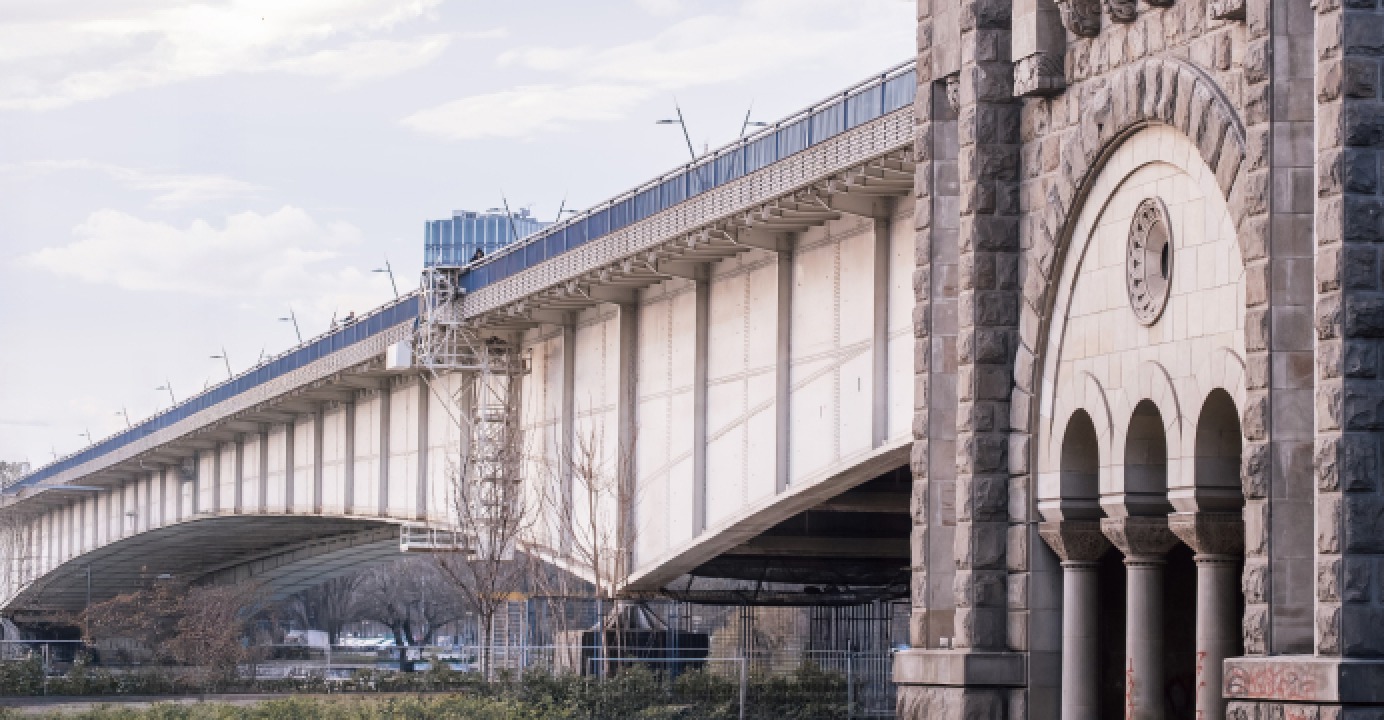
Branko’s Bridge
Branko’s Bridge is an iconic crossing over the Sava, a symbol of the unity of Belgrade and Zemun, combining Romano-Byzantine architectural motifs with a rich historical meaning.
0.7 km
8 min
Бранков мост, Белград
Architects
Those who shaped the look of the route's points,
learn their biographies and contribution to the face of the city.