The National Assembly of Serbia
An iconic building of Belgrade, a symbol of Yugoslav statehood, built in the style of the Italian Renaissance.
округ Белград, Старый Город, Трг Николе Пашича, 13
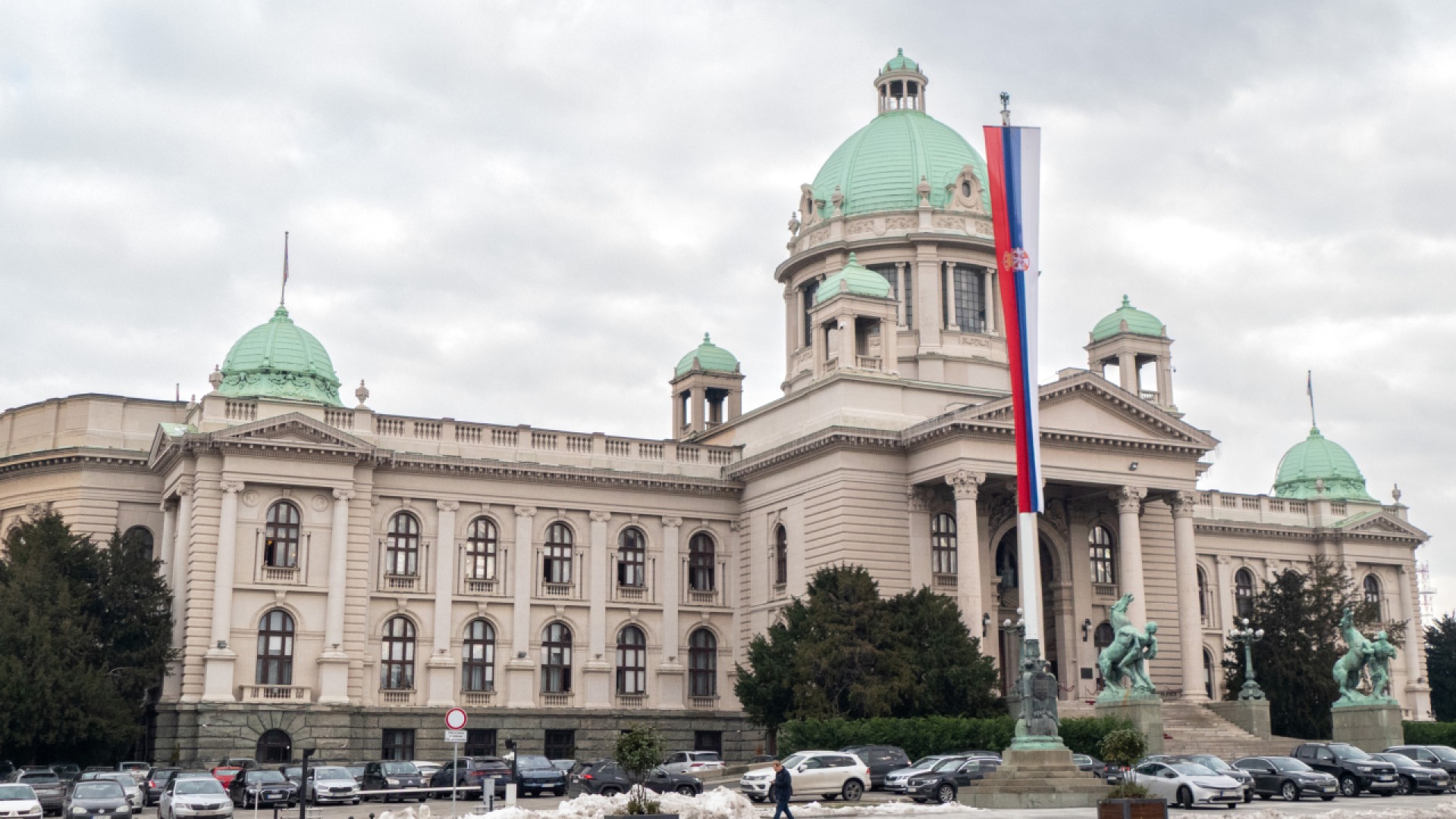
We begin our route at the place where this language of power acquired its material form. Before us stands the National Assembly — one of the most recognizable symbols of Belgrade and an imprint of the era in which Yugoslav statehood was being formed.
We are standing on Nikola Pašić Square. The construction of the building took almost thirty years, from 1907 to 1936. Its history began as early as 1892, when the architect Konstantin Jovanović proposed a design for a representative “palace of politics” for a unicameral parliament. After its difficult struggle for independence, Belgrade needed a monumental building that would symbolize its status as a capital and its autonomy. But at the beginning of the twentieth century, a new constitution changed the political system: parliament became bicameral, the Senate appeared — and the old project no longer corresponded to the new reality.
In 1902, a competition was announced. The winner was the Serbian architect Jovan Ilkić. He took Jovanović’s idea as a basis and reworked it, creating a design for the “House of National Representation” — a building intended to bring together under one roof the National Assembly, the Senate, the State Council, and numerous administrative offices. In 1907, under King Peter I Karađorđević, the foundation stone was solemnly laid. It seemed that everything was only just beginning.
History has repeatedly confirmed that violence becomes a catalyst for major historical shifts. The Balkan Wars and the bloodshed of the First World War interrupted construction: the work was halted, resumed, and then suspended again for many years. Only in the mid-1930s did construction enter its final phase. From 1934 onward, the site was overseen by Nikolai Petrovich Krasnov — a Russian émigré, former architect of the imperial court, academician of architecture, and creator of the Livadia Palace. After the 1917 Revolution, he found himself in Belgrade and became an architect of the Ministry of Construction. It was he, a Russian, who was destined to give the Assembly its completed appearance.
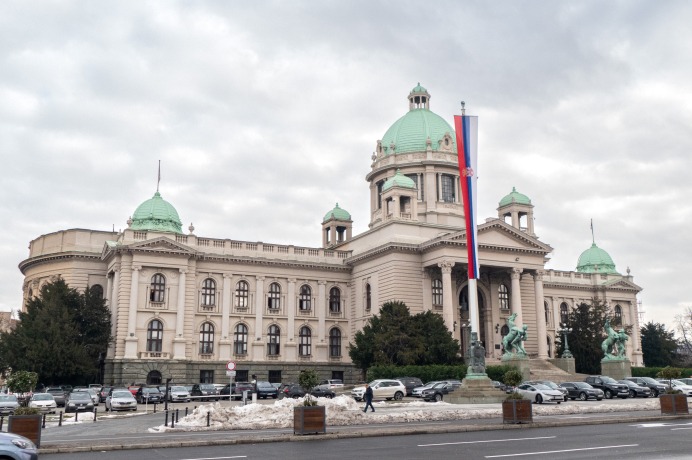
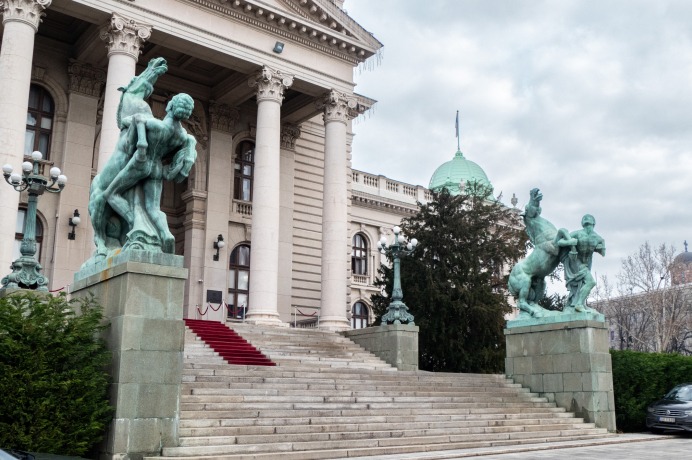
Krasnov did not alter the architectural foundation — its academic monumentality had already been established. Before us stands a freestanding palace in the spirit of the Italian Renaissance: a central portico with a triangular tympanum, Corinthian columns, a powerful dome with a lantern, four smaller domes at the corners, and a strict symmetry of the façade. The central staircase rises like a ritual path, symbolizing hierarchy and state power.
But the most important thing Krasnov did was to create the building’s inner world. The interiors were designed down to the smallest detail: doors, chandeliers, light fixtures, furniture, decorative elements, and the fence around the park — all were developed in a unified style.
Inside, there is a ceremonial vestibule beneath the dome, polychrome walls, a marble floor, coats of arms, and sculptures of rulers. The Great Assembly Hall, lined with walnut wood, with rich stucco decoration and furniture, was initially designed for 200 and later for 400 deputies. In the left wing is the Senate Hall. Two symmetrical staircases of white marble are adorned with bronze allegories of justice and enlightenment. In 1937, the walls were decorated with twenty frescoes by outstanding Yugoslav artists. Among the sculptures are Petar Palavičini’s allegory of seafaring and fishing, and the figure of Emperor Dušan by Dragutin Filipović.
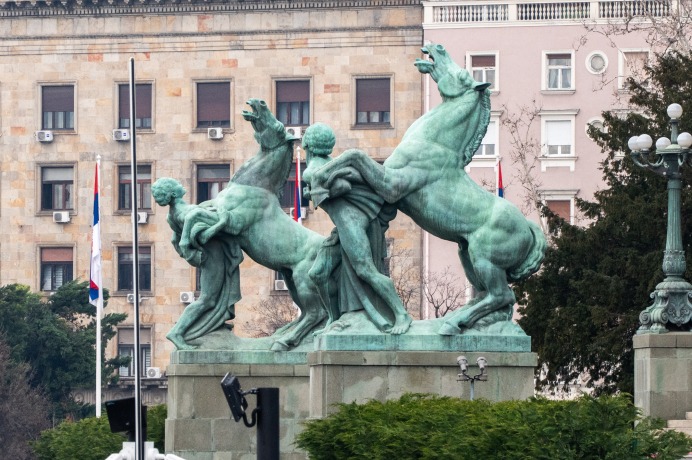
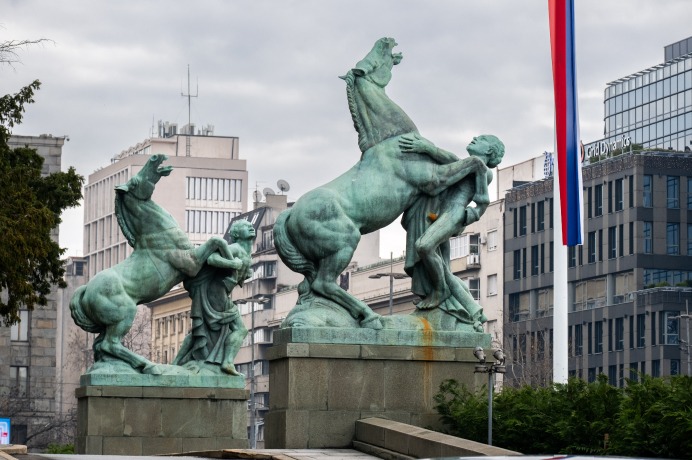
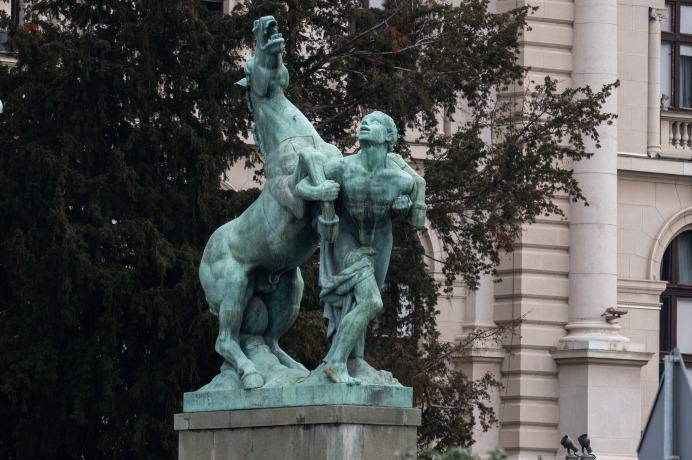
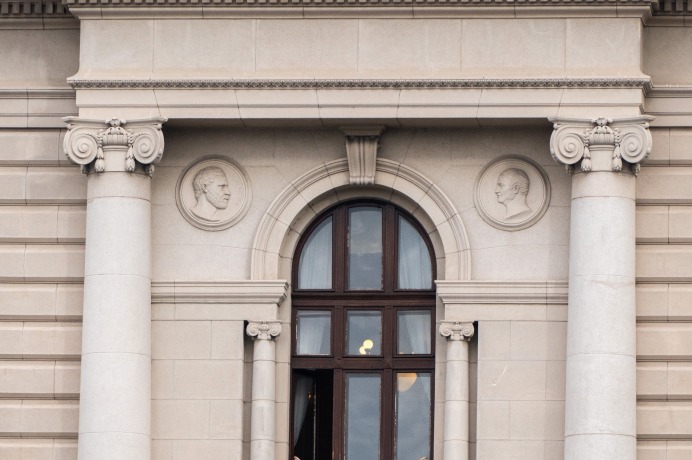
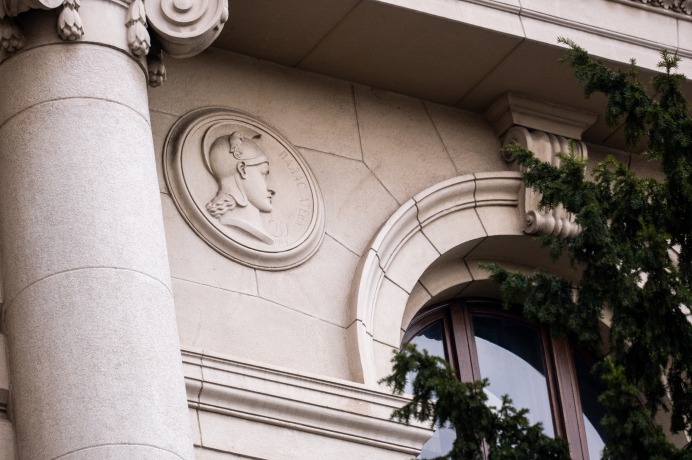
On the façade are medallions with Athena and the figures of Pericles, Demosthenes, and Cicero, created by the sculptor Đorđe Jovanović — a gesture toward Antiquity. At the portals stands an angel with a torch and an olive branch, conceived by Petar Palavičini. Since 1939, in front of the main entrance, there have stood Toma Rosandić’s bronze Playing Black Horses — horses frozen in motion that compel even the passer-by to stop and look at their stature and power.
The site on which the Assembly stands is also interesting. Before construction began, the so-called Batal Mosque, one of the most beautiful Turkish mosques in Belgrade, stood here. In 1830, the Great National Assembly was held on this site, where the Sultan’s hatt-i sharif on the rights of the Serbs was read and Miloš Obrenović’s right to hereditary rule was confirmed. The mosque was later demolished, but the memory of it long survived in the name of the district.
The building was solemnly consecrated on 18 October 1936 in the presence of King Peter II. The very next day, the first session was held here — and almost immediately a new political whirlpool began. The Parliament of the Kingdom of Yugoslavia existed in this building for only three years.
In April 1941, Belgrade was subjected to bombing, yet the Assembly was almost undamaged — the architectural shell survived, while the state itself was destroyed. After the country’s capitulation, the building entered the space of occupation power: the civil administration was housed here. There is an almost ironic historical paradox in this: the symbol of Yugoslav sovereignty was incorporated into the infrastructure of external control.
At the same time, alongside the functioning of the occupation apparatus, a powerful resistance movement unfolded in the country — the partisan struggle, which gradually formed an alternative source of legitimacy. Thus, during the war, the Assembly building existed in a dual historical perspective: physically, it served the occupation order, while symbolically it was already becoming the future stage of a new power born in struggle.
After the liberation of Belgrade, the organs of the new socialist government were housed here. It was in this building that the Federal People’s Republic of Yugoslavia was proclaimed, later the Socialist Federal Republic of Yugoslavia. Constitutions were adopted here; key political sessions took place here, including the 1961 Conference of the Non-Aligned Movement, which consolidated the country’s special international position. It was also here, in 1980, that people bid farewell to Josip Broz Tito — the leader of Yugoslavia, whose figure largely determined the political trajectory of the state in the second half of the twentieth century.
Today, the National Assembly remains the parliament of Serbia and has held the status of a cultural monument since 1984. It stands surrounded by the New and Old Palaces, the Historical Museum of Serbia, the Main Post Office, and Pioneer Park — in the very heart of administrative Belgrade.
But the Assembly, while being a cultural monument, has also been a place where history is made: on 5 October 2000, the parliament became one of the main symbolic targets of the protesters. As the scholar Aleida Assmann writes in Forgetting History — Obsession with History: “Vandalism is a symbolic and demonstrative form of defeating an opponent by destroying his cultural heritage.” During the mass protests against the regime of Slobodan Milošević, demonstrators stormed the Assembly building, set it on fire, and partially destroyed its interiors; this was an act of dismantling the regime. The seizure of parliament marked the loss of legitimacy of the existing authorities: in revolutionary practice, taking control of government buildings means the transfer of control over the state. Thus, the building conceived as an architectural embodiment of state stability and parliamentarianism became, in 2000, the stage of a public rupture with the previous political order.
Architects
Nikolai Petrovich Krasnov
Routes
Imperial
Address
округ Белград, Старый Город, Трг Николе Пашича, 13