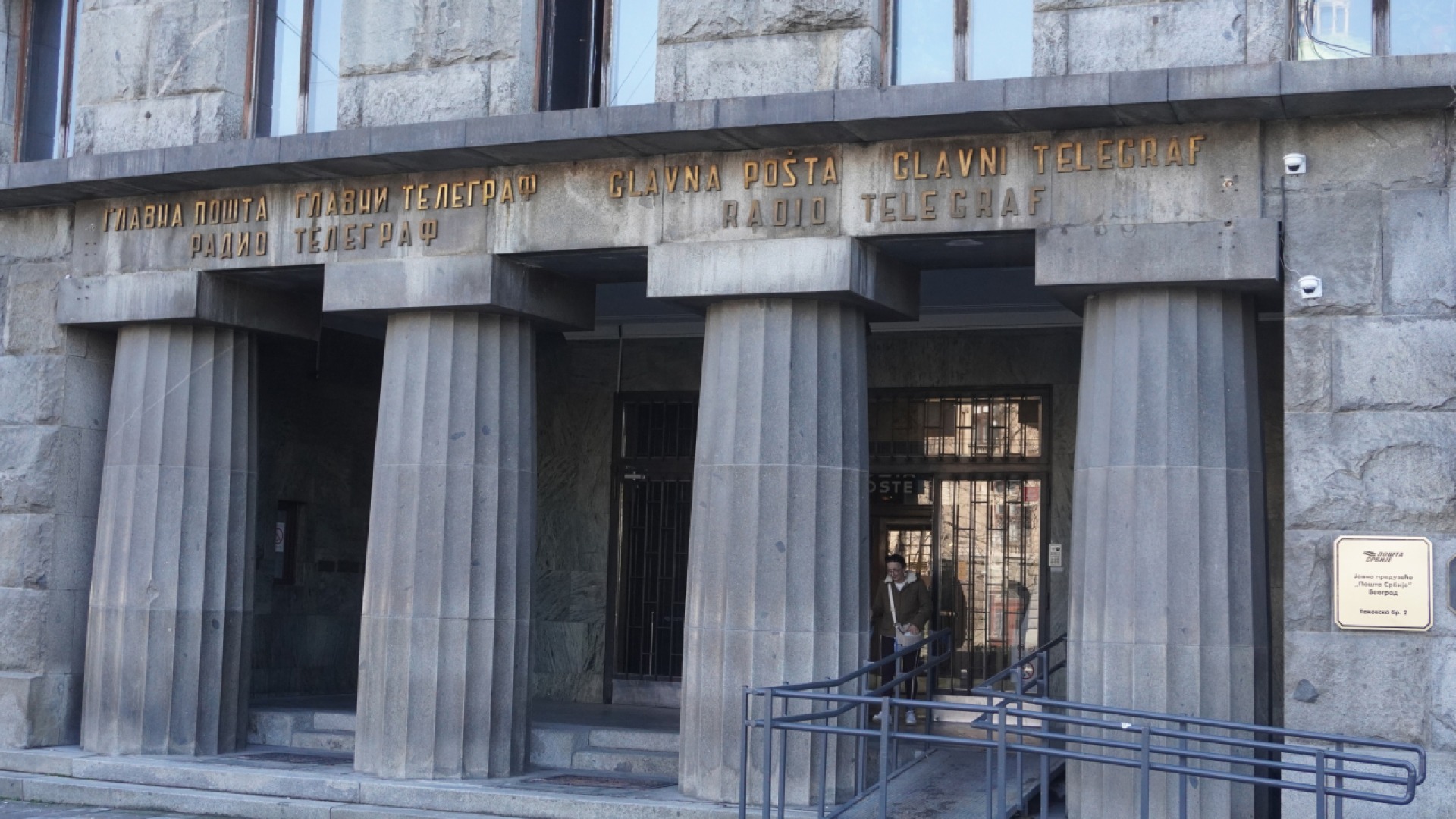
The Main Post Office and the Constitutional Court of Serbia
A monumental academicist building of the 1930s, which became a symbol of scale, urban identity, and Belgrade’s modern transformations.
бул. Короля Александра, 15, Белград
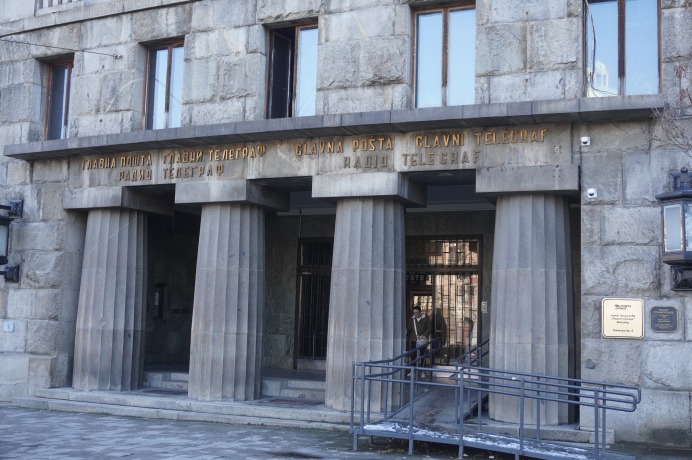
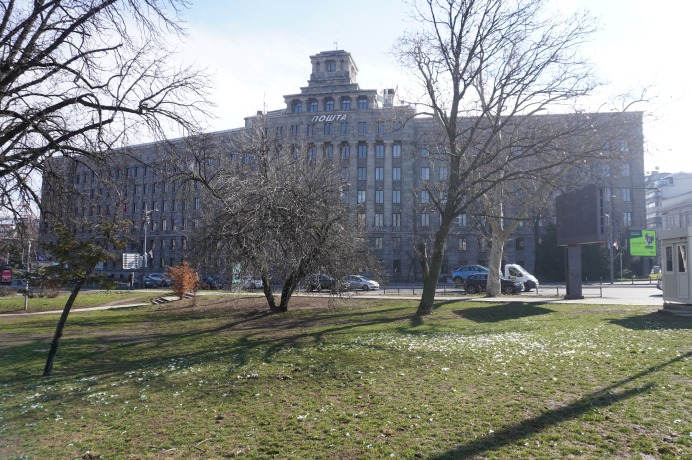
At last, we have reached a building with “two faces” — the Main Post Office and the Constitutional Court of Serbia. In Belgrade, the reconfiguration of a building, and with it the radical reassembling of its identity, is almost an everyday matter. Before us stands one of the most recognizable, and at the same time one of the heaviest and most massive buildings in Belgrade. The Main Post Office on the corner of King Alexander Boulevard and Takovska Street is difficult not to notice: it seems to grow into the intersection, giving it its scale. Massive, austere, and emphatically monumental, it has long been part of the urban landscape — for Belgraders and visitors to the capital alike.
The building was erected in the late 1930s according to the design of the Russian émigré architect Vasily Androsov. Its silhouette is sometimes compared to examples of German architecture of the same period — an association born, rather, from the shared language of 1930s monumentality than from any direct influence. Before us is an example of late interwar academicism: strict symmetry, heavy volumes, and a grand scale designed to make the building appear as a state institution.
But the history of this place began long before the post office appeared. As early as 1921, here on Tašmajdan, a far more ambitious project was being discussed — the construction of a new multi-level railway station. Trains were to go underground, pass through tunnels, and only then emerge to the surface. For the young state, the idea proved too expensive: the estimate reached one billion dinars. Yet the concept itself was ahead of its time: the tunnel under Terazije, conceived then, was realized only in the socialist period.
The railway station project also included a post office building — and it was this building that was ultimately decided upon. At first, the competition was won by the young Croatian architect Josip Pičman. However, King Alexander Karađorđević personally rejected his design, and the work was entrusted to Androsov. The king did not live to see the completion of construction: he was assassinated in Marseille in 1934. Pičman, meanwhile, took his own life in 1936; according to one version, the tragedy was connected with the failure of the Belgrade project, while according to another, it was linked to difficulties in constructing a skyscraper in Rijeka. Creative people are prone to impulsive acts; in the final part of our route, we will be forced to recall this story once again.
But now, let us return to the building of the Main Post Office. The southern wing of the building, facing King Alexander Boulevard, was originally intended for the Poštanska štedionica bank. In the 1940s, the National Bank of Serbia moved here, and since 2013 the Constitutional Court has been located here.
The wartime history of the building is no less dramatic. In the spring of 1941, after the Wehrmacht invasion and the creation of puppet regimes, the consulate of the Independent State of Croatia was housed in the Main Post Office. The consul was first Josip Lančarević, then Ante Nikšić. A year later, the consulate moved to Dorćol, but it was here that this page of occupation history began. A curious and grim fact: despite the brutal regime of the Independent State of Croatia, not a single action against its representation in Belgrade was recorded during the entire existence of the consulate.
As we were walking, did you notice the traffic light? Interestingly, it was precisely at this intersection that Belgrade’s first traffic light appeared in 1939. By that time, the city already had more than 400,000 inhabitants: trams and buses ran through the streets, carts and automobiles rattled along, but there was still no electric traffic regulator. The corner of Takovska, King Alexander Boulevard, and the then King Ferdinand Street became a symbol of modernization. By 1957, the city had only sixteen traffic lights; they would become widespread only in the 1960s.
Routes
Imperial
Address
бул. Короля Александра, 15, Белград