Ministerial
This route is indeed short in distance, but very dense in meaning: you walk along a street where interwar Yugoslavia quite literally built the image of the state in stone
4 Points
8 min
0.7 km
Audio guide
This route is indeed short in mileage, but very dense: you are walking along a street where interwar Yugoslavia quite literally built the image of the state in stone. Here one can see especially clearly what scholars of the Russian emigration write about: émigré architects trained in the academic school became almost “state architects” in the Kingdom of Yugoslavia - their monumental neoclassicism was ideally suited to representing strength, stability, and order.
In other words, this is a short route backed by a long history: interwar Yugoslavia was constructing its statehood and political identity - and entrusted that task to architects in exile.
We are in Belgrade - but right now we are discovering a special Belgrade: not bohemian, not touristy, not sacred, but administrative. This part of the city was built and - importantly - completed when, after the First World War, a new state emerged and needed new “organs” to ensure the functioning of its political body: ministries, agencies, and palaces of administration.
The scholar of the Russian emigration V. Kosik writes in the book What Do I Care About You, Belgrade Pavements?: “People have always had the habit of leaving something to others. In essence, our entire civilization is built on this ‘other,’ and architecture is brilliant confirmation of that statement.”
You can feel that idea physically here: Belgrade really is assembled “on the other” - on someone else’s experience, on imported professionalism, on the émigré’s eye, which sees the capital afresh.
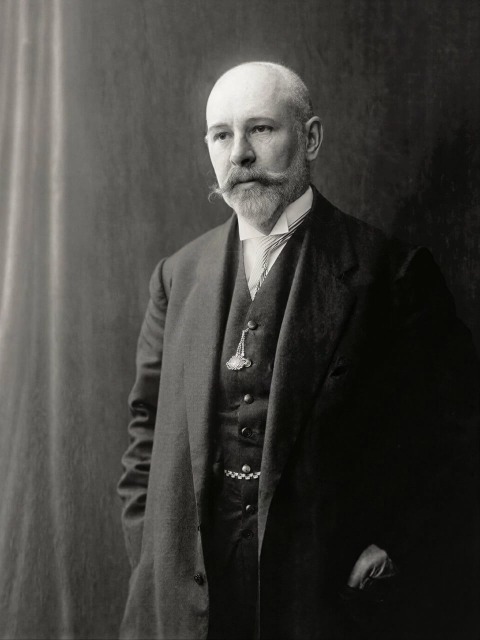
Today our main character is Nikolai Petrovich Krasnov. Before the revolution he built for the imperial court and worked in Crimea, including designing the famous Livadia Palace; after emigration he ended up in the Kingdom of Yugoslavia and became one of the key figures shaping the official architectural language of Belgrade.
Krasnov’s buildings are not simply “beautiful houses.” They are a translation of political ideas into architectural language: symmetry, rhythm, strict articulation, corner domes, heavy cornices, sculptural allegories. All of this seems to tell the passerby: here is power, here is order, here is the center. And our route begins with that without which no state can be imagined - finance and the budget. Our first stop is the Ministry of Finance.
Stop 1: Kneza Miloša 20 - Ministry of Finance
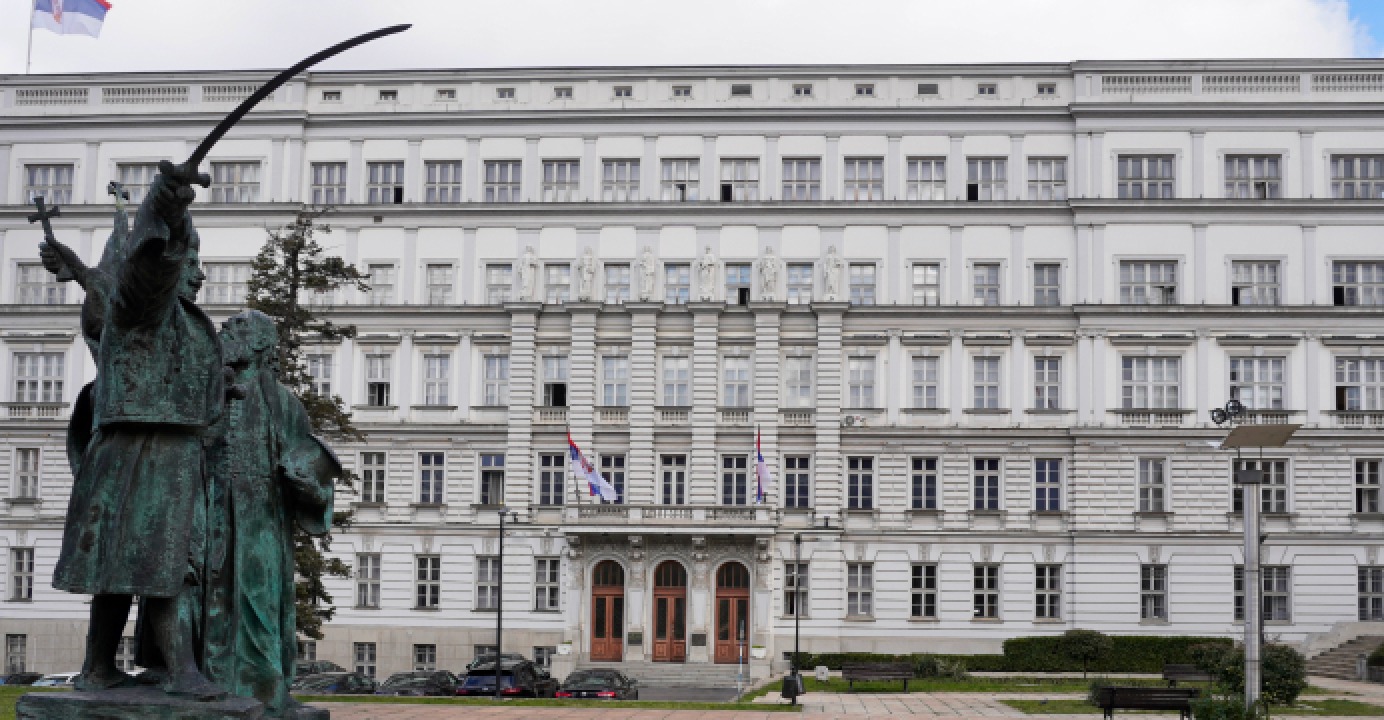
The history of the building begins not in the 1920s, but much earlier. According to official data from Serbia’s Ministry of Finance, the building at 20 Kneza Miloša was erected in 1889 for the state administration to the design of the architect Dušan Živanović; it originally housed the State Council and the Main Control Administration. In 1920, “according to the same design,” a second floor was added to the building.
Then, in 1924, Krasnov appears and does something that would later be repeated many times in different variations: he transforms a functional administrative box into a building that reflects the pillars on which the new Yugoslav political identity was being built. According to Krasnov’s design, the building was rebuilt into a unified quadrangular composition with an inner courtyard.
Now, to feel the meaning of this reconstruction, imagine not the façade but the movement of people inside. An inner courtyard in a government building is a way of organizing an institution as an organism (and this is no accident, because the state is nothing other than a political organism): on the outside - ceremony and representation; on the inside - the corridors of power, or its “circulatory system.”
Pay attention to the very logic of the street. Kneza Miloša Street is a straight line along which, piece by piece, an ensemble of power takes shape, a chain of “significant objects” where old ministerial buildings, parks, monuments, and government offices stand side by side.
There is another important detail - this time about the building’s modern fate. In 1959 a third floor was added; after the Second World War federal planning and statistical institutions were housed here, and in 2004 Serbia’s Ministry of Finance moved into the building.
And finally, its protected status: the building lies within the protected zone along Kneza Miloša Street and forms part of historic Belgrade under a cultural protection regime.
Now we will make a short castling move. This often happens in Belgrade: a building is erected for one ministry and ends up becoming the symbol of another. We are heading to the building of the Ministry of Foreign Affairs - which originally was not “diplomatic” at all.
Stop 2: Kneza Miloša 24-26 - Ministry of Foreign Affairs
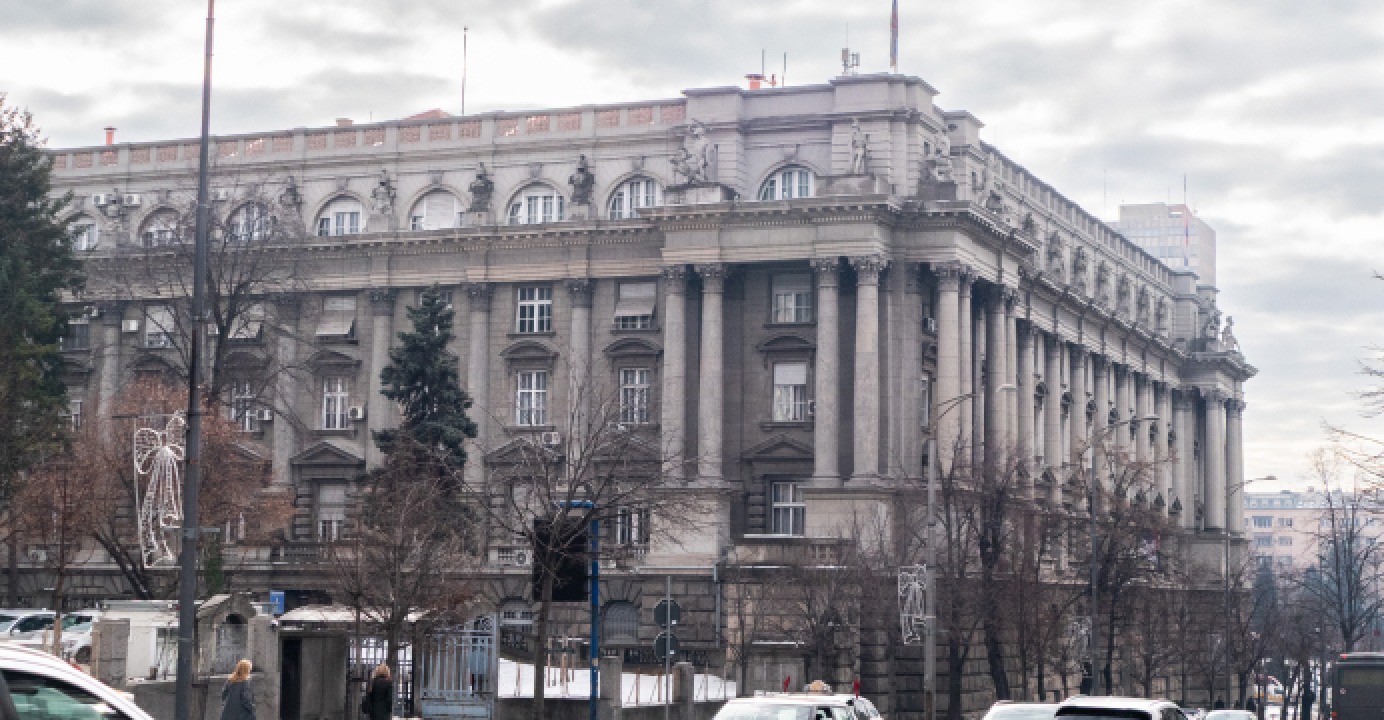
Strange as it may sound, today’s Serbian Ministry of Foreign Affairs is the former building of the Ministry of Forests and Mines and the Ministry of Agriculture and Waters. The building was originally constructed for these two departments, and its current function is the result of circumstance and the twists of history.
Architecturally, this is one of the most representative examples of Belgrade’s interwar academicism. And the story of its construction really does resemble a detective tale - about how a project “passes from hand to hand,” preserving its foundations while changing its meaning.
According to the Belgrade Institute for the Protection of Monuments, in 1923 the architects Dragiša Brašovan and Nikola Nestorović developed the design, and the building was erected up to the level of the first floor. Then, in 1926, completion of the work was entrusted to our old acquaintance Krasnov: he preserved the general concept, but re-read it in his own way, developing a new façade scheme and an interior design, and turning the unfinished structure into a completed, ideologically state-oriented image.
The façades are deliberately broken up and animated: the rhythm of the windows, the high roof cornice, the balustrades, the rich plasticity. Most importantly, the corners are emphasized by grand domes - the building becomes the dominant feature of the intersection.
The freestanding sculpture and reliefs were made in bronze and artificial stone from designs by the Serbian sculptors Dragomir Arambašić, Živojin Lukić, and Petar Palavičini. They symbolize the spheres of activity of the ministries. On the tops of the domes are allusions to forestry and the harvest, while on the façades there are references to animal husbandry, agriculture, and viticulture.
Farther along Kneza Miloša stands a building where the Russian architectural history of Belgrade speaks not in Krasnov’s voice, but in another name. We are heading to the “Stone Palace,” the old General Staff building (not to be confused with the new complex), where special military services are housed today.
Stop 3: Kneza Miloša 33 - “Stone Palace,” Baumgarten’s Old General Staff
An important clarification is needed here. This building is not by Krasnov - but it is made of the same “semantic material.” It is also the work of a Russian émigré architect and one of the key symbols of interwar academicism on Kneza Miloša.
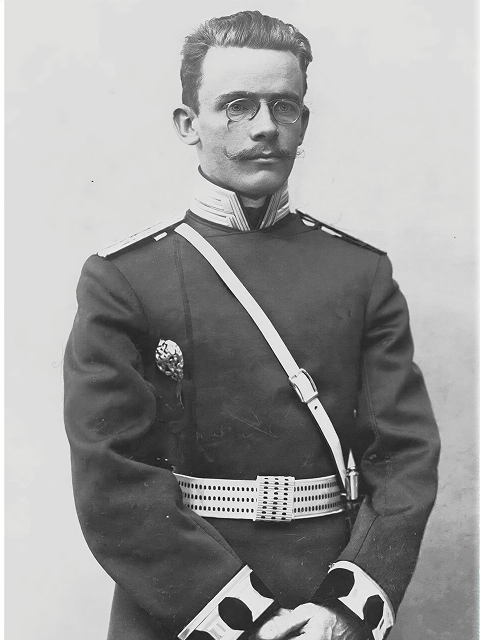
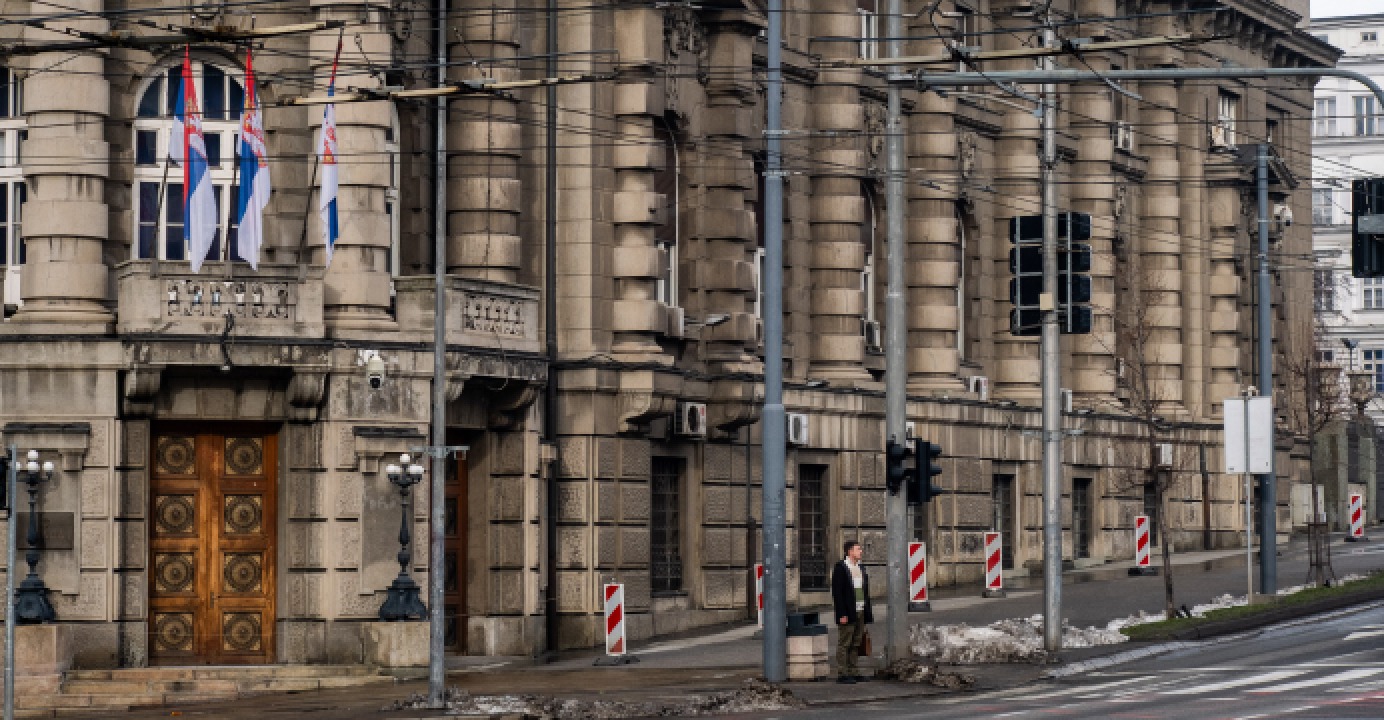
Before you is the building of the old General Staff, also known as the “Stone Palace” or “Baumgarten Palace.” It was built in 1924-1928 to the design of the émigré architect Vasily Wilhelm Fyodorovich Baumgarten. The building is often described as “exceptionally monumental and decorative,” one of the best examples of public architecture in interwar Belgrade in the academicist spirit.
The interior is very richly finished; a variety of materials were used in the treatment of the floors, walls, and ceilings, and the decorative elements refer to antiquity and the Renaissance. Stylistically, the interior is closest to the Russian Empire style that dominated the first half of the nineteenth century. The central staircase at the entrance is flanked by parapets; above them rise pairs of twin columns supporting a coffered ceiling. The coffers are filled with floral rosettes. In the longitudinal corridor, the ceiling is decorated with stucco and painting with motifs from the Renaissance decorative program.
And finally, the composition: a monumental entrance to the ceremonial hall, treated with double columns of roughly hewn stone and a pediment; above it is the figurative relief “Samson and the Lion,” executed by Vladimir Zagorodnyuk. “Samson and the Lion” symbolize strength and struggle - a narrative entirely appropriate to a military space.
Now we return to Krasnov and to the final point of the route - the building of the Government of Serbia, the symbolic “knot” of the street, where architecture gathers the intersection into a fist.
Stop 4: Government of Serbia - Nemanjina 11 (corner of Kneza Miloša)
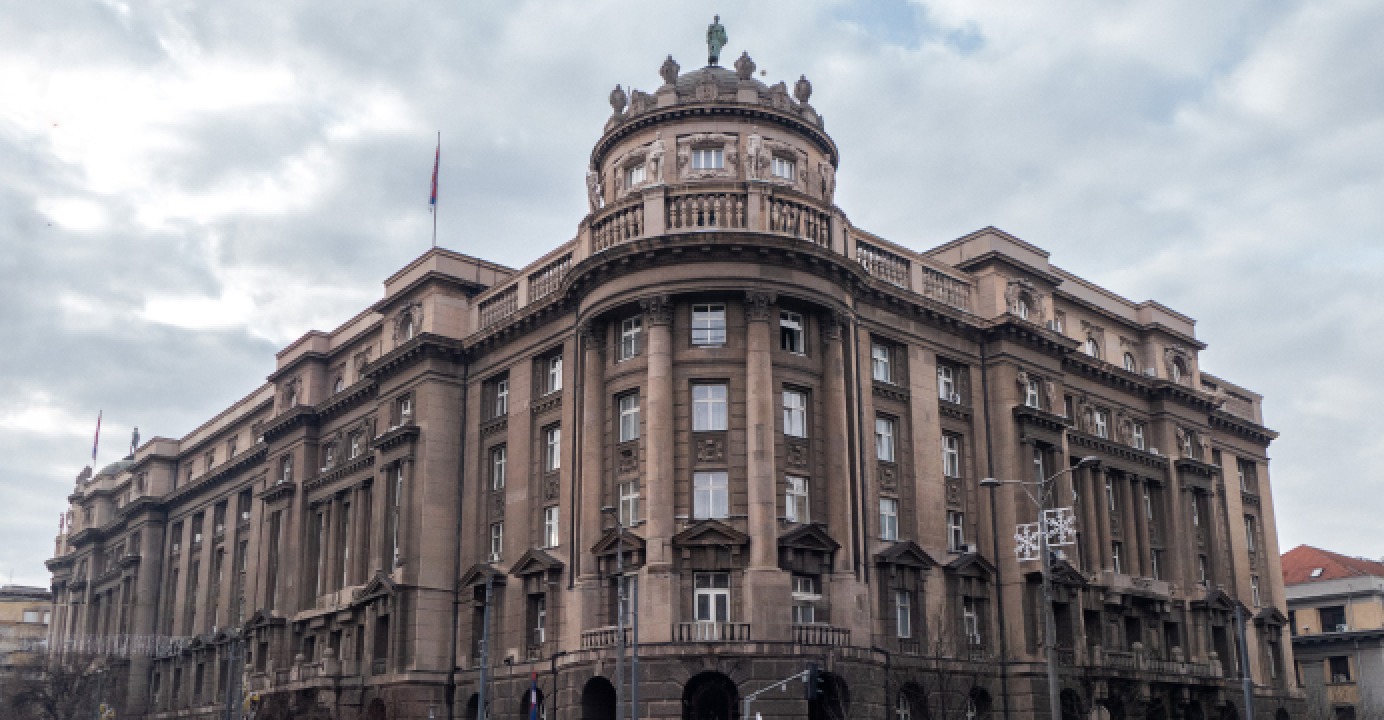
The building of the Government of Serbia is one of the central points in Belgrade’s state topography. At the same time, you are standing on the corner - and part of the façade also faces Kneza Miloša: this is precisely the “corner” that Krasnov turns into a stage.
The building was constructed in 1926-1928 to the design of Nikolai Krasnov and was originally intended for the Ministry of Finance.
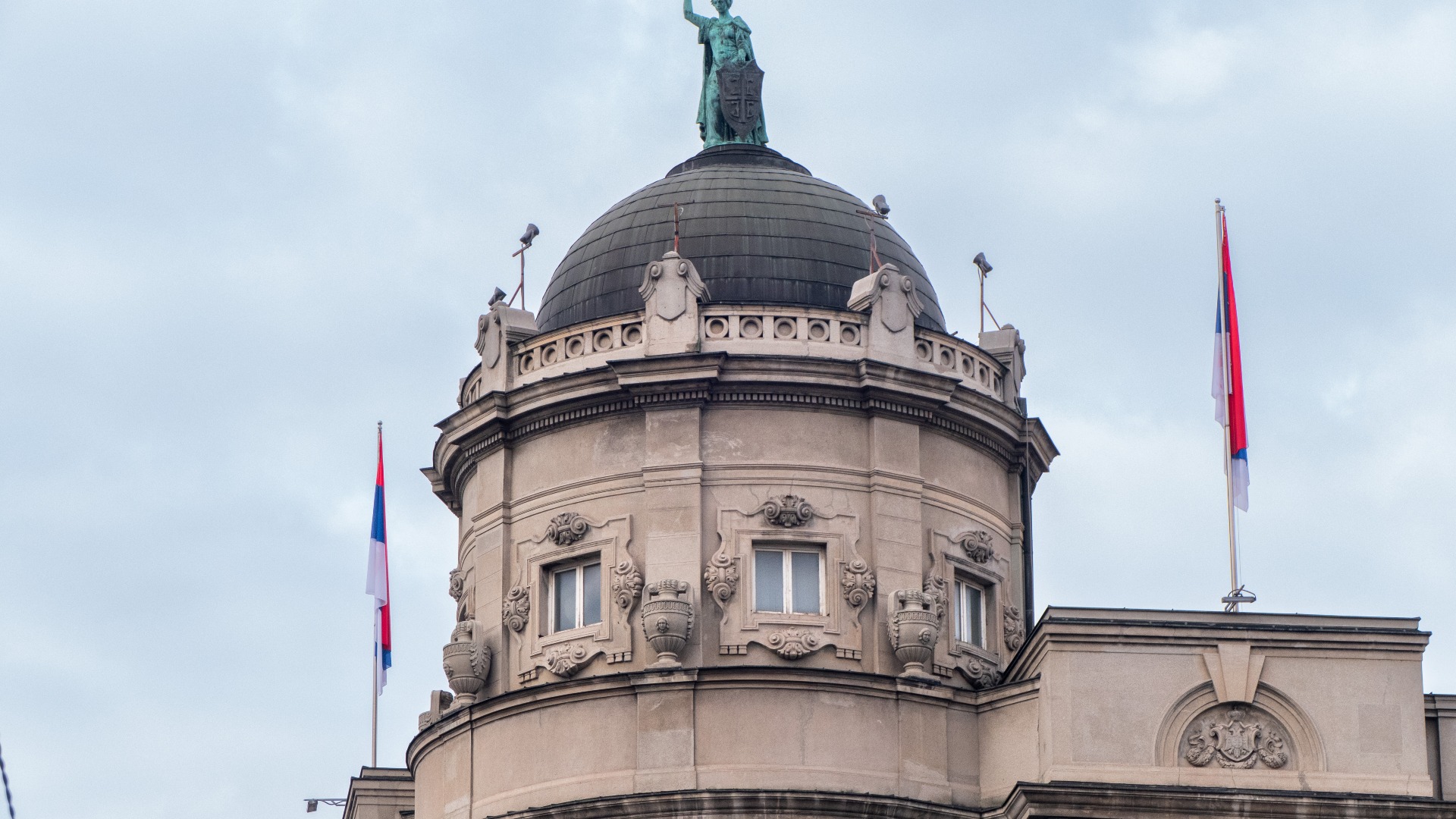
The plan of the building is a square with an inner courtyard; the façades, in an academic style, are maintained in a monumental rhythm; massive pilasters and cornices create “ornamental projections,” while the window surrounds establish a strict rhythm. And the most interesting place is precisely the corner. Krasnov especially loves the “corner” because in the street perspective it is the corner that meets a person first. The building stands out through its emphatic treatment of the corner: massive pilasters dominate the surroundings, underscoring the importance of the state functions carried out here in Yugoslavia and carried out today in Serbia.
Its vertical line is emphasized by a domed termination, and at the top stands a bronze sculpture personifying Yugoslavia. The author of this figure and the façade allegories is the sculptor Đorđe Jovanović. What are these allegories? Their names sound like a pantheon of economic gods: Fertility (with a cornucopia), Art, Industry, Mercury - the god of trade. And the choice of these motifs is explained by the building’s original purpose: the Ministry of Finance was meant symbolically to embody the economic foundations of the state.
And there is one more dramatic storyline - this time from the end of the twentieth century. During the NATO air strikes in 1999, the building was seriously damaged; its façades were scarred, its interiors damaged, and restoration took about a year.
An eyewitness, the Serbian writer Milorad Pavić, writes about this in his story “Biography of Belgrade”: “The third millennium began in Belgrade a year earlier than everywhere else. In 1999 eighteen countries of Western Europe and the United States, members of NATO, attacked Yugoslavia. During seventy-eight days of air raids these new crusaders dropped on Belgrade and other cities of Serbia more explosive material than was detonated in Hiroshima at the end of the Second World War. One of Belgrade’s main streets, Miloš the Great Street, has been unrecognizable ever since.”
And here we are, on a street whose original appearance was literally erased by strikes - a street that survived not only changes of eras and regimes, but the direct destruction of its own urban fabric. Today its façades have been restored, glass once again reflects the sky, movement has returned to its familiar rhythm, but the memory of 1999 remains inscribed in the space - like a hidden layer of the city’s biography.
Belgrade knows how to recover, but it does not erase the traces completely: beneath the renewed surface there always remains the knowledge that this landscape was once torn apart and then reassembled.
History, as we can see, does not end with the completion of a façade. It continues in the cracks of stone, in traces of shrapnel, in the political and human conflicts that overlay architecture with a new layer of meaning.
And if this building was restored and once again incorporated into state life, the fate of the other General Staff building (do not confuse them!) - the complex destroyed in 1999 - still has not been definitively resolved.
Its ruins remain a painful point in the city’s memory: caught between the idea of restoration, conservation, and possible new development. Thus architecture continues to live in a state of open question and constant discussion - as a reminder that a state in stone is never once and for all complete.
Finale
This journey is a portrait of the state within a single city block. We walked only a few hundred meters, yet saw an entire political biography of the country laid out in stone.
Here, on Kneza Miloša and the neighboring streets, power gave shape to itself, searching for its own image. If we look more deeply, this route reveals another, subtler story: how Russian émigré architects, having found themselves in Yugoslavia after the catastrophe of revolution and civil war, became part of the DNA of its state visuality.
They arrived here having lost their homeland, without their former status, often without resources. But they also brought a school with them - academic training, experience with imperial commissions, and the ability to think of space as a system of signs.
This quarter is not only about the political organism and the ways it functions, but also about how architecture can become the language of a lost homeland and at the same time an instrument of a new one. About how “outsiders” become insiders (architect Nikolai Krasnov even signed himself as Nikola!).
Thus our “Ministerial” route comes to an end. But, like all architecture of power, it does not place a full stop - it leaves the feeling of an ongoing conversation between history, memory, and the city.
Route points
The Ministry of Finance of Serbia
A historic administrative complex and a symbol of Belgrade’s architectural and political development.
Start
ул. Кнеза Милоша, 20, Белград
The Ministry of Foreign Affairs of Serbia
A striking example of interwar academicism and an architectural landmark of Belgrade.
0.37 km
4 min
ул. Кнеза Милоша, 24–26, Белград
The “Stone Palace,” Baumgarten’s Old General Staff Building
Before you stands the building of the old General Staff, also known as the “Stone Palace” or “Baumgarten Palace.” It was built between 1924 and 1928 according to the design of the émigré architect Vasily Wilhelm Fyodorovich Baumgarten.
0.19 km
3 min
ул. Кнеза Милоша, 33, Белград
The Government of Serbia
A monumental building with a corner composition, a dome, and sculptures, embodying the idea of the state and the experience of trials endured.
0.14 km
1 min
ул. Неманина, 11, Белград
Architects
Those who shaped the look of the route's points,
learn their biographies and contribution to the face of the city.