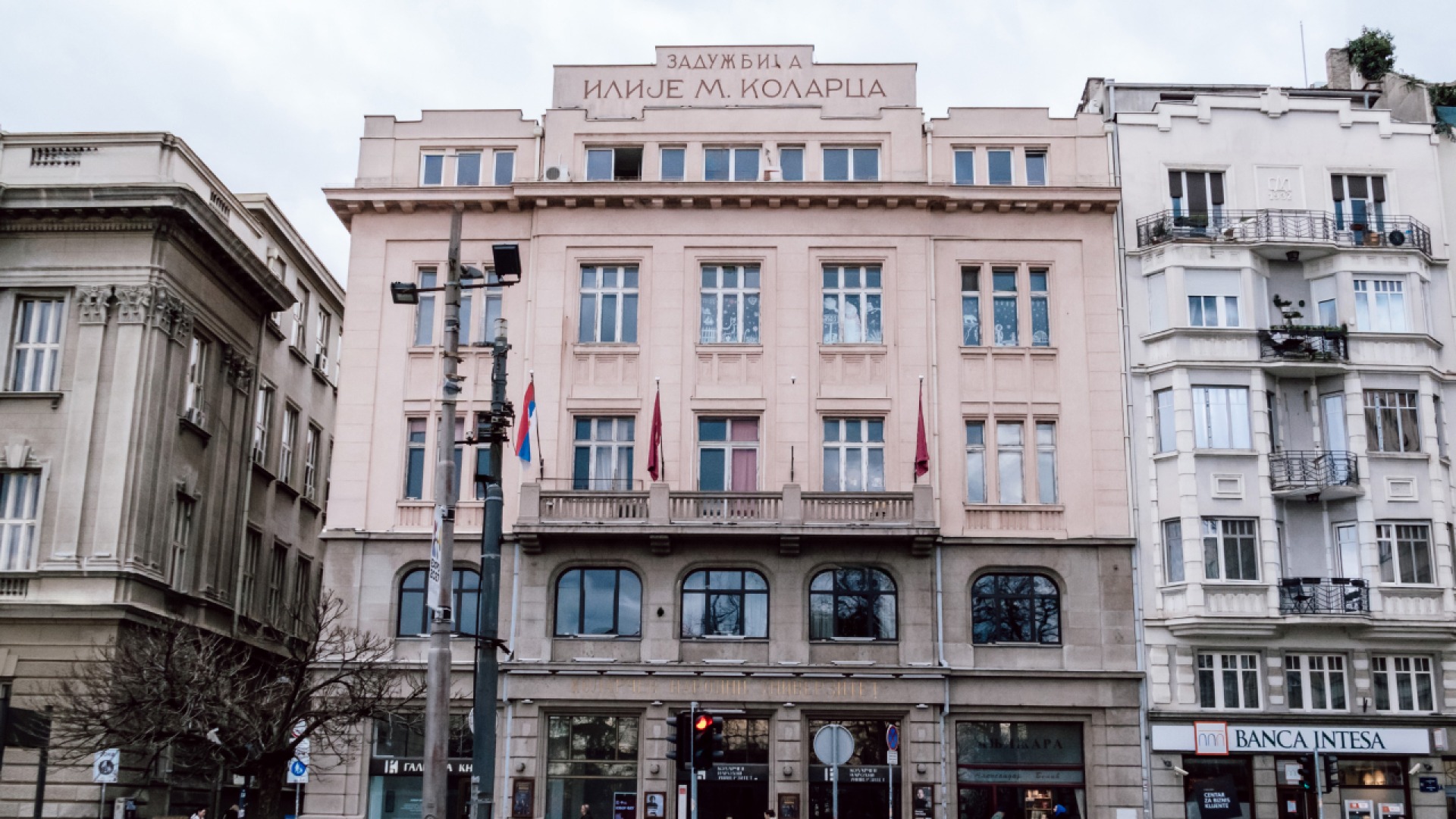
Kolarac
A symbol of the Enlightenment tradition and of a social contract with the future, bringing together academic architecture, the unique acoustics of its concert hall, and an active urban cultural life.
Студентски трг, 5, Белград
In Serbian, the cultural centre of Ilija Kolarac is called Zadužbina Ilije Kolarca — and not by chance. In Serbian culture, the word zadužbina means not merely charity, but a kind of contract with the future: an investment in something that does not yet exist, but ought to come into being. Ilija Milosavljević Kolarac left a foundation for education and culture — and the city received an institution that does not conserve knowledge, but constantly produces it in public form.
Many years later, Aleida Assmann would write in The Long Shadow of the Past: Memory Culture and Historical Politics: “Conservation and preservation serve as the necessary precondition for cultural memory; however, only the individual perception, evaluation, and assimilation of preserved materials — as occurs through the mass media, cultural and educational institutions — make it cultural memory.” It turns out that the Serbian patron anticipated history.
As you walk here, let us recall: Russian refugees arrived in Yugoslavia in waves; sources give different estimates of their numbers, and in Belgrade itself they already numbered in the thousands. Associations began to appear — professional and cultural ones: unions of engineers, teachers, doctors, artists. In other words, emigration quickly turned into a network of connections, and this network needed platforms — one of which is precisely here.
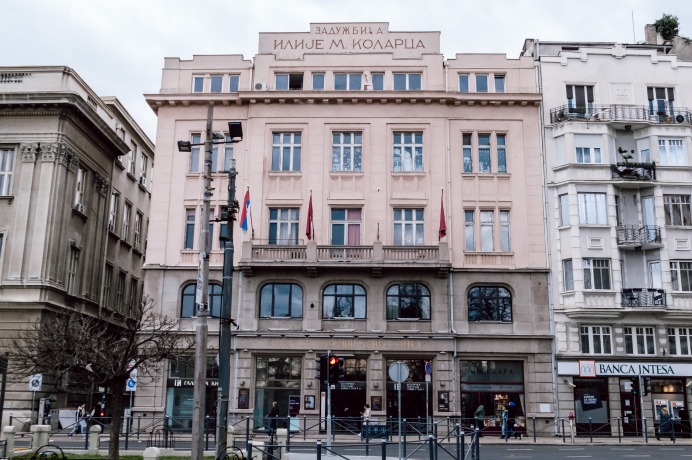
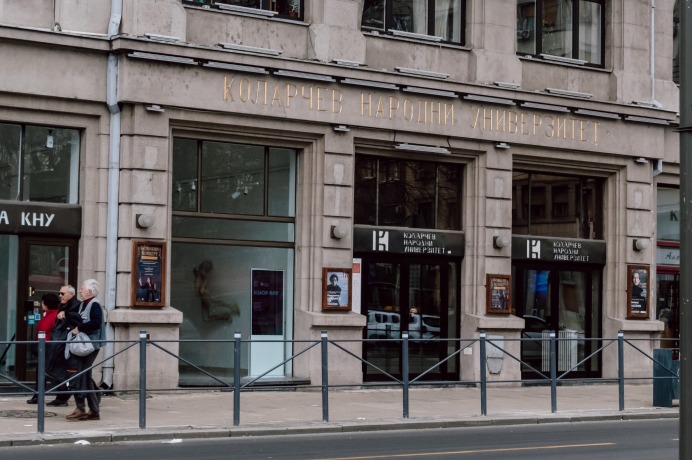
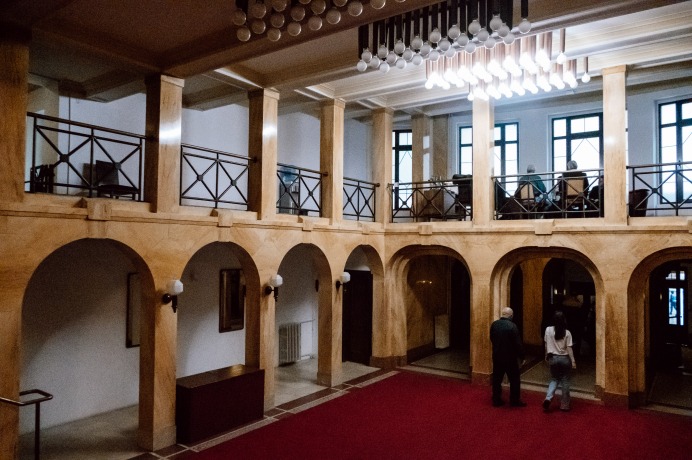
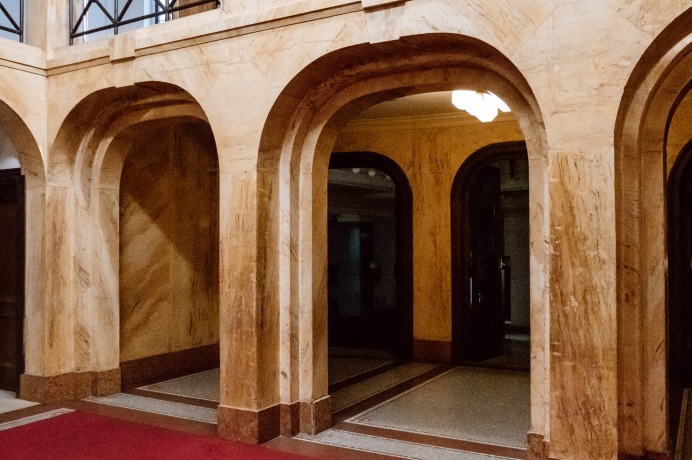
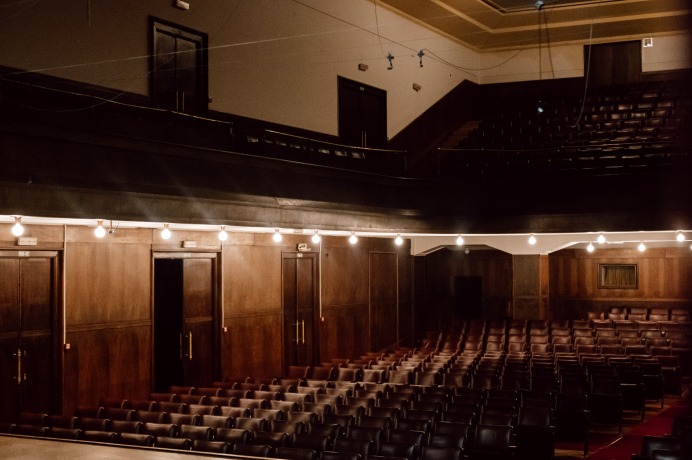
The building of the Kolarac People’s University was constructed between 1929 and 1932 according to the design of Petar Bajalović. Its architecture is marked by calm academicism: symmetry, clear composition, the façade as a dignified shell for culture. But the main thing here is not the façade, but sound. The Great Hall was conceived as an instrument, and this can be felt even when you are simply standing nearby: the place seems intended to make the city pause for a second… and become an attentive listener.
“But where are the Russian architects here?” an attentive listener might ask. And they would be right to ask. The construction of the Kolarac People’s University involved Pyotr Anagnosti, already familiar to us, and Andrei Papkov, whom we now invite you to meet. If only because the following verses were written about him:
I want to be daring, I want to be worldly,
I want to be on familiar terms with maidens!
I want to be a Turkish pasha,
And build arches and bridges!I am doing a good deed,
I have built everything, I am wiser than everyone.
In the twentieth century, Michelangelo
Could perhaps be only Papkov Andrei.There are not many like me today,
My ancestor Lenka was da Vinci.
I am immeasurably more talented than all,
And that is why life is not bad for me.
Andrei Vladimirovich Papkov was born in 1890 in the village of Glubokoe in the Kursk region. He managed to receive a technical education in St Petersburg and studied at the Academy of Arts. But the revolution broke the straight line of his biography, and Papkov, like thousands of others, found himself in exile. Together with his family, he came to the Kingdom of Serbs, Croats and Slovenes and began again — this time as a student in the Department of Architecture at the University of Belgrade.
In Belgrade, he quickly became a notable figure. His student projects — an exhibition pavilion in the Serbian-Byzantine spirit, a casino, a grand theatre conceived “in the finest spirit of the Paris Opéra Garnier” — aroused interest and debate. He received the title of engineer-architect, taught ornamental drawing, and took part in the design of the Church of Saint Sava, where his gift as a watercolourist proved indispensable in creating the artistic part of the project. He was called a “descendant of Leonardo da Vinci” — for his universality, for the rare combination of engineering precision and painterly temperament.
In 1932, Papkov opened his own atelier, and interwar Belgrade became his workshop. He designed dozens of residential buildings — harmonious, proportional, decorated with neoclassical ornament, but always with a slight modernist turn. The house for Milutin Mesarović, the building for Plavšić, the Janković villa, rental buildings on quiet streets — all of this formed a recognizable signature. The culmination was the Balkan Hotel (1938–1939): its enormous façade, in the spirit of Russian academic architecture, seemed to affirm in the centre of the capital the dignity and scale of émigré talent. He participated in the competition for the Kolarac People’s University, received prizes — eighteen awards for various projects — but did not always receive the right to build what he had conceived. In this lay both the glory and the hidden bitterness of his fate.
The war broke the rhythm of construction: instead of new façades came the clearing of ruins and the restoration of damaged buildings. After 1945, hopes for broad professional fulfilment in the new Yugoslavia did not come true. He did build one more villa on Dedinje — austere, with a hint of socialist realism — but he felt that the era had changed, and that the language he had mastered so perfectly was no longer in demand. In 1951, Papkov left for Argentina. In Buenos Aires, he worked in a ministry, designed for private companies, and participated in the construction of the cathedral of the Russian Orthodox Church Outside Russia on Núñez Street — as if closing the circle of an exile’s fate.
He died in Argentina around 1975, having lived a life divided between three worlds: pre-revolutionary Russia, interwar Belgrade, and Latin American emigration. But if you walk through the streets of old Belgrade and raise your eyes to the strict, balanced façades of the 1930s, you can see the trace of his hand — the hand of an architect who managed to turn exile into a form of creativity.
Let us return to Kolarac. The first major concert took place on 4 February 1932 — even before the official opening. Kolarac began by sounding, and only afterwards became a cultural institution. Over the decades, thousands of concerts have taken place here; among the performers were Sergei Prokofiev and Sviatoslav Richter. Russian musical tradition entered Belgrade’s everyday life naturally, as part of the European canon. For example, the researcher of Russian emigration V. Kosik writes: “One can also name another well-known singer — the baritone Nikolai Mikhailovich Ammosov (Amosov). During the day he sang at the Kolarac cinema four times before screenings, and in the evenings at the ‘Russian Family’.”
Kolarac is not only a concert hall; it is also lectures, a gallery, and educational programmes. In short, one of those fashionable “third places” — neither home nor work, but a place where you feel comfortable thanks to shared values and a common cultural code. This cultural code, the possibility of sharing it with a community of kindred spirits, is the leitmotif of our route today. And it seems that these values were important then, just as they are today.
And now we will move from the people’s university to the university in the original sense of the word, the centre of intellectual life — the University of Belgrade. We will begin with the Faculty of Law.
Routes
Academic
Address
Студентски трг, 5, Белград